
Blog
Security Robot Rental: What Pricing Says About Vendors
A monthly rental price is the visible figure. Contract length, maintenance schedule and the failover model decide whether that price is actually honest.

Dr. Raphael Nagel
April 6, 2026
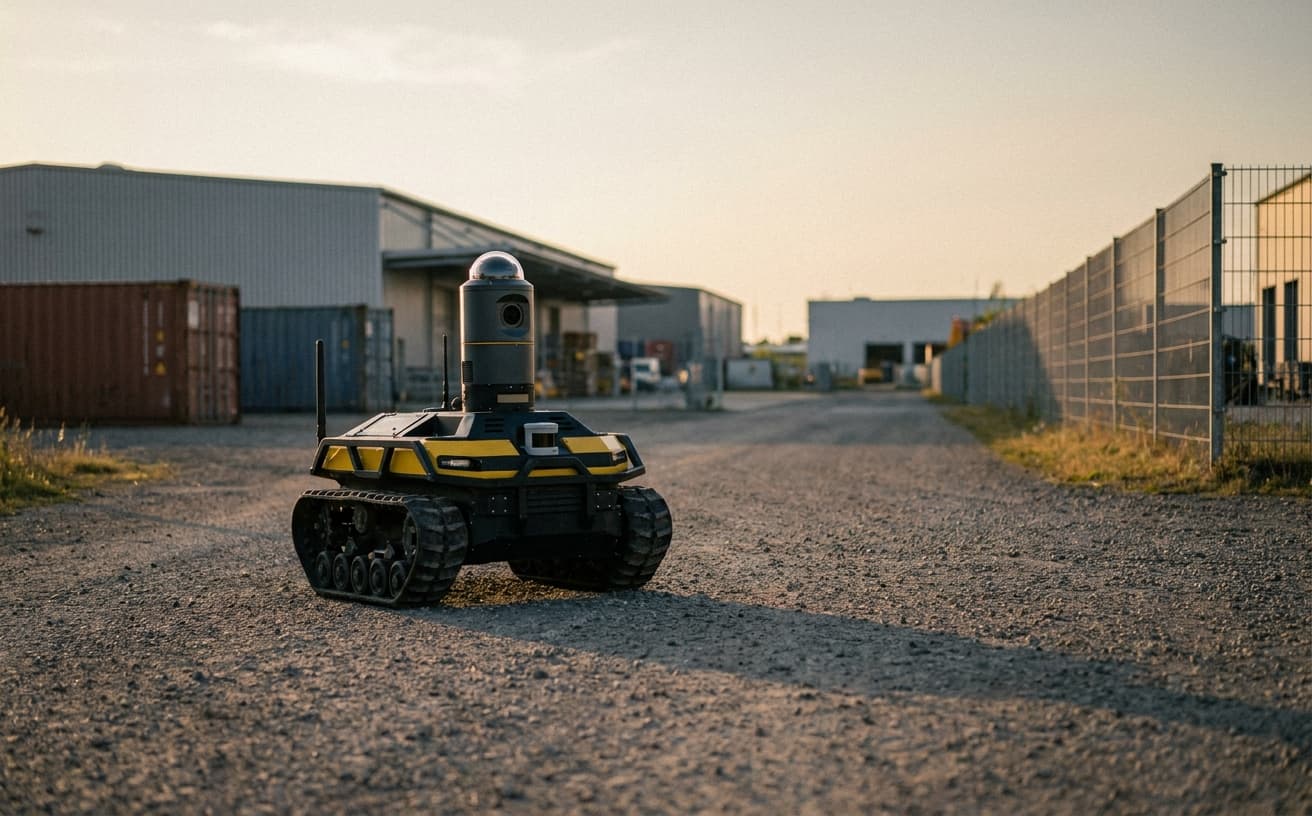
A rental price is not a price. It is a summary of decisions the vendor has already made about hardware lifetime, service load, response architecture, and acceptable risk, compressed into a single line on a quotation.
That summary is useful, but it is useful only in the way a thermometer is useful. It tells the operator what the vendor's organisation runs at, not what the operator will actually pay over the life of the deployment. A monthly figure that looks competitive against three others on a desk often hides a maintenance model that the vendor cannot sustain at that price, or a failover assumption that has never been tested under load. The figure becomes honest only when the contract length, the maintenance schedule, the response chain, and the exit conditions are placed next to it.
What follows is written for operators who have received at least one rental quotation for a security robot and now want to read the rest of the document. The objective is not to defend a particular price point. The objective is to give a procurement-side reader the questions that turn a price into a position.
What the monthly figure actually represents
A monthly rental figure for a security robot in continental Europe currently sits in a wide band. At the lower end, an operator may see numbers that look closer to the cost of a part-time guard. At the upper end, the numbers approach the fully loaded cost of a permanent technical installation with operator support. Both ends of the band can be defended, and both can be misleading, depending on what they include.
The figure represents, in principle, the amortisation of the hardware over an assumed deployment life, plus the cost of software licensing, plus the cost of preventive and corrective maintenance, plus a margin for the vendor, plus the cost of the operator's connection to a monitoring centre if that is bundled. It also represents, less visibly, the vendor's assumption about how often the unit will fail, how quickly a replacement can be brought to site, and how many of those replacements the price can absorb before the contract becomes unprofitable.
An operator who reads the figure without asking how the vendor arrived at it is reading a number. An operator who asks how the figure decomposes is reading a position. The decomposition matters because the components scale differently. Hardware amortisation is a function of unit cost and deployment life. Software licensing is a function of feature set and update cadence. Maintenance is a function of mean time between failures and the vendor's service density in the operator's region. Margin is a function of competitive pressure and the vendor's appetite for the segment.
When a quotation is significantly cheaper than its peers, one of those components is being squeezed. The operator's job is to find out which one, before the contract is signed rather than after. A vendor squeezing margin can sustain that for a quarter or two. A vendor squeezing maintenance density will fail in month four, when the unit goes down and the nearest service technician is six hours away. The failure pattern is consistent enough across the industry that NIST CSF 2.0 lists supplier resilience as one of the explicit governance functions, and ISO 27001 treats it under supplier relationship controls. The principle is older than either standard. It is the principle that an asset is only as available as its weakest service dependency.
Contract length as a vendor signal
A vendor's preferred contract length tells the operator more about the vendor's confidence in the product than any datasheet does. A vendor who insists on a thirty-six month minimum is telling the operator that the unit economics do not work below that horizon. A vendor who offers a three-month rolling contract is telling the operator that the platform has been built to be redeployed, that the hardware is robust enough to survive multiple site changes, and that the service organisation is dense enough to absorb the operational variability.
Both signals can be honest. They describe different business models, not different levels of seriousness. The thirty-six month contract typically carries a lower monthly figure, because the vendor can spread the deployment costs, the integration work, and the training overhead across a longer base. The three-month rolling contract carries a higher monthly figure, because each redeployment cycle costs the vendor real money and the price has to reflect that.
The operator's question is not which model is cheaper in the abstract. The question is which model matches the operator's own time horizon. A construction site with a defined eighteen-month programme should not enter a thirty-six month contract for a single asset, unless the vendor has explicitly built portability into the agreement and the operator has a credible plan for the second site. An industrial operator with a permanent perimeter should not pay rolling-contract prices for an installation that will not move for five years. The mismatch in either direction is expensive, and the expense is usually invisible until the contract is well underway.
The contract length also encodes the vendor's view of obsolescence. A vendor who builds platforms for ten-year lifecycles will write longer contracts because the firmware roadmap supports it. A vendor whose hardware turns over every twenty-four months will avoid longer contracts because they expose the gap between what was sold and what will be supported. An operator can read this by asking, directly, how long the current generation of the robot will receive security updates, and what the upgrade path looks like when that generation is sunset. Vendors who answer with specifics are vendors whose contracts can be trusted on length. Vendors who answer with reassurances are vendors whose contracts should be kept short regardless of the discount on offer.
What maintenance actually covers
Maintenance is the line item that separates a rental from a purchase, and within a rental, it is the line item that separates a serious offer from a thin one. The relevant question is not whether maintenance is included. The relevant question is what is included, who performs it, on what schedule, with what response time guarantee, and what happens when the guarantee is missed.
A serious maintenance schedule for a security robot includes preventive intervention at defined intervals, typically quarterly, covering mechanical wear, sensor calibration, battery health, and firmware updates. It includes corrective intervention on demand, with a response time that is specified in hours rather than days, and a resolution time that is specified in days rather than weeks. It includes parts and labour without further invoicing for any failure not caused by misuse, with misuse itself defined in the contract rather than left to the vendor's later interpretation. It includes documented escalation paths when the first response does not resolve the issue.
A thin maintenance schedule looks different. Preventive intervention is described as available rather than guaranteed. Corrective intervention carries response times in business days, with no weekend coverage. Parts are included but labour is invoiced separately, or labour is included but parts above a certain value trigger a separate quotation. The escalation path leads to a customer service number that operates during office hours. None of these features are dishonest in themselves. They are simply incompatible with a security application where the absence of the asset for forty-eight hours converts the rental into an expense without a function.
IEC 62443, in its treatment of industrial automation security, makes a distinction between the operational environment and the service environment surrounding it. The same distinction applies to security robotics. The robot is the operational asset. The maintenance organisation is the service environment. A failure in the service environment produces a failure in the operational asset, and the operator pays for both. ASIS International guidance on physical security programme management treats service-level definitions as the second-order question that procurement teams most often defer and most often regret. The deferral is structural. It happens because the monthly figure is concrete and the maintenance schedule is abstract, and concrete numbers win attention. The regret is also structural. It happens in the first incident.
Failover and the redundancy question
A security robot is a single point of failure when it is deployed alone. The rental contract should make this explicit, and the vendor's pricing should reflect what happens when the unit is unavailable. There are three credible answers. The first is that the rental price includes a guaranteed replacement window, after which a substitute unit is on site and operational. The second is that the rental is structured around a deployment of two or more units with mutual coverage, so that the failure of one does not produce a gap. The third is that the operator accepts the risk of single-unit deployment with a defined gap, in exchange for a lower price, and the contract documents this acceptance.
All three answers can be defended. The answer that cannot be defended is silence. A vendor who does not address failover in the contract is selling the unit without selling the function. The operator who signs such a contract is buying an object, not a capability. CISA's guidance on operational technology resilience treats redundancy planning as a first-order procurement question rather than a maintenance afterthought, and the logic transfers cleanly to physical security automation.
The pricing implication is straightforward. A failover model with a guaranteed twenty-four hour replacement window adds cost, because the vendor must hold inventory in the relevant region and dispatch it on demand. A failover model with co-located redundancy adds cost, because the operator is paying for two units where one was budgeted. A failover model that exists only on paper, with vague language about commercially reasonable efforts, costs less, but the cost is moved from the rental line to the next incident. The book BOSWAU + KNAUER. From Building to Security Technology treats this transfer of cost as the central honesty test of any security technology procurement, and the test applies in both directions. A vendor who refuses to price failover explicitly is hiding the cost. An operator who refuses to pay for it is hiding the risk.
Hidden costs in the rental envelope
A rental quotation typically excludes several categories of cost that the operator will incur regardless. These categories are not hidden in the sense that the vendor conceals them. They are excluded in the sense that they fall outside the vendor's control and therefore outside the vendor's price. The operator who treats the rental figure as the total cost of the deployment is making a procurement error, not catching a vendor in deception.
Site preparation is the first category. A security robot requires defined paths, charging infrastructure, network connectivity, and lighting conditions sufficient for its sensor package. A site that already meets these conditions adds nothing. A site that does not meet them adds an amount that can range from minor to substantial depending on the existing infrastructure. The vendor should walk the site before the contract is signed and document the preparation requirements in writing. An operator who accepts a quotation without this walk is accepting an unknown.
Integration with existing systems is the second category. A robot that operates as an island has a fraction of its potential value. A robot integrated with the operator's video management system, alarm receiving centre, access control, and incident workflow delivers the value that justifies the rental price. Integration work is project work. It is quoted separately, it takes time, and it requires both parties to commit engineering resources. The vendor's openness about this work is a strong indicator of the vendor's seriousness. A vendor who claims that integration is included without scoping it is making a promise that integration teams will later have to renegotiate. A vendor who scopes it carefully, with hours and deliverables, is making a promise that can be held.
Insurance and regulatory compliance form the third category. The robot is an asset, and the asset has to be insured. The vendor may include this in the rental, or may leave it to the operator. The contract should be explicit. Beyond insurance, the deployment may trigger data protection obligations, particularly where video and audio recording is involved, and may require notification or consultation with works councils in jurisdictions where this applies. The GDV in Germany has published guidance for insurers on the underwriting treatment of mobile security platforms, and the guidance assumes that the operator, not the vendor, holds the regulatory responsibility. The BSI has published equivalent guidance on the cybersecurity posture of networked physical security devices, and the same allocation applies there. The operator who treats the rental as a turnkey solution is operating on an assumption that the regulatory framework does not share.
Operator labour is the fourth category. A security robot reduces patrol labour. It does not eliminate the labour of the human who watches the output, responds to alerts, and intervenes when the situation requires it. A rental quotation that implies otherwise is not describing a deployment, it is describing a marketing brochure. The credible quotation reduces labour by a defined factor, against a defined baseline, with a defined methodology. The book referenced above treats the ratio of human attention to automated coverage as the operational figure that decides whether the deployment pays for itself, and the ratio is always above zero.
How to read a quotation against a vendor's organisation
The quotation is a document produced by an organisation. The honesty of the document is bounded by the honesty of the organisation that produced it, and an operator can learn a great deal about that organisation without ever signing a contract.
The first signal is how the vendor handles questions about the unit's failure history. A vendor who provides mean time between failures, by generation, with the methodology, is operating at the level of an industrial supplier. A vendor who provides reassurances about reliability without numbers is operating at the level of a marketing department. The difference is not preference. The difference is whether the operator can plan around the unit's behaviour or has to discover it.
The second signal is the reference base. A vendor with a deployed fleet in the operator's segment can provide references who will talk candidly. References who will talk only in the vendor's presence, or only about features rather than incidents, are references managed for marketing rather than offered for verification. ASIS International's procurement guidance recommends a minimum of three independent references with at least eighteen months of deployment history, and the recommendation holds up well in practice.
The third signal is how the vendor responds to a request for a short trial. A vendor confident in the product offers a structured pilot with defined success criteria and a clean exit. A vendor uncertain in the product offers a discounted long contract instead. The structured pilot is more expensive per month than the long contract. It is also the only format that allows the operator to verify the product against the operator's own conditions, rather than against the vendor's curated demonstrations.
The pilot itself, for an operator considering a meaningful commitment to security robotics, is the appropriate engagement format. BOSWAU + KNAUER operates a ninety-day pilot path for exactly this reason. The pilot has a defined site, a defined success measure agreed before installation, and a defined data deliverable at the end. The operator pays for the pilot. The operator is not obliged to convert. If the operator does convert, the pilot fee is credited against the contract. If not, the operator retains the data and walks away with a ninety-day picture of the operator's own security posture that is not available through any other format. For operators not yet ready for that depth of engagement, a sixty-minute confidential conversation with a member of the leadership is available, with no follow-on cost and no follow-on obligation. The conversation is either the result, or it is the start of one of the two longer engagements.
What holds
The rental price for a security robot is a useful figure only when it is read against the contract length, the maintenance schedule, the failover model, and the costs that fall outside the rental envelope. Read alone, it is a number that suggests competitiveness without proving capability. Read in context, it becomes a position from which procurement decisions can be defended in the boardroom and in the loss adjuster's office.
The vendor evaluation that matters is not the comparison of monthly figures. It is the comparison of organisations, their willingness to be specific about failure, their density of service in the operator's region, their openness to a structured pilot, and the alignment of their contract length with the operator's own horizon. An operator who runs this evaluation will sometimes choose the more expensive quotation and sometimes the cheaper one. The choice will be defensible in either direction, because it will be based on what the price represents rather than on what the price displays.
The path forward for an operator who has read this far is short. Either the operator already has the answers to the questions raised here, in which case the procurement is mature and the next step is a vendor shortlist. Or the operator does not yet have the answers, in which case the next step is a conversation that produces them. Both paths are legitimate. Only the third path, signing a contract without the answers, is not.
Frequently asked questions
What is the typical monthly rental for a security robot?
Monthly rentals in continental Europe currently sit in a wide band, from figures comparable to part-time guard cost at the lower end to figures approaching a fully loaded permanent technical installation at the upper end. The variation reflects differences in hardware specification, included maintenance, response time guarantees, software licensing, and contract length. A figure quoted in isolation tells the operator very little. The same figure, decomposed into hardware amortisation, software, maintenance, margin, and bundled monitoring, tells the operator whether the price is sustainable for the vendor and appropriate for the operator's risk profile.
What is included in a security robot rental contract?
A serious contract includes the unit itself, software licensing and updates, preventive maintenance on a defined schedule, corrective maintenance with response time guarantees in hours, parts and labour for non-misuse failures, firmware support across the contract term, and a documented escalation path. It typically excludes site preparation, integration with existing operator systems beyond defined interfaces, insurance, regulatory compliance work, and the human operator labour required to act on the robot's output. The contract should be explicit about both inclusions and exclusions. Silence on either side produces dispute in the first incident.
Are short-term rentals available?
Short-term rentals exist, with terms as short as three months on rolling renewal, but they carry higher monthly figures than longer commitments. The economics are honest. Each redeployment cycle costs the vendor in transport, reconfiguration, site qualification, and training. A vendor offering short terms at long-term prices is either subsidising the offer to win the account or has not modelled the redeployment cost. Operators with defined project horizons, such as construction programmes, should match the contract length to the programme and negotiate portability between sites rather than chasing the shortest available term.
Who is responsible for maintenance during a rental?
In a rental structure, maintenance is the vendor's responsibility, and this responsibility is the principal difference between a rental and a purchase. The relevant question is the depth of the responsibility. A vendor responsible for preventive intervention on a quarterly schedule, corrective intervention within defined response times, parts and labour for non-misuse failures, and firmware support across the term is carrying the full operational risk. A vendor whose maintenance language is vague on response times, schedules, or parts coverage is transferring risk back to the operator without adjusting the price. The contract decides which arrangement applies.
Related topics
- Security Robots For Sale vs Rental: When CapEx Actually Wins
- Outdoor Security Robots: What Spec Sheets Hide About IP66
- Security Robot vs Human Guard: The Honest Five-Year Math
- Extreme Heat & Security Robots in the Gulf: 55C
- Security Robots in Saudi Arabia: Vision 2030 & NEOM
Take the next step: See prices & ROI · Explore the products · Send a no-obligation request. BOSWAU + KNAUER – direct from the factory in Filderstadt, reply within 5 working days.
About the author
Dr. Raphael Nagel (LL.M.) is founding partner of Tactical Management. He acquires and restructures industrial businesses in demanding market environments and writes on capital, geopolitics, and technological transformation. raphaelnagel.com
More reading
Since 1892.
The firm is reached at boswau-knauer.de or +49 177 2266267.