
Blog
Security Robots in Saudi Arabia: Vision 2030 & NEOM
Saudi NCA, HCIS, NEOM smart city plans. Where autonomous security fits in a kingdom rebuilding industry from scratch.
Dr. Raphael Nagel
May 8, 2025
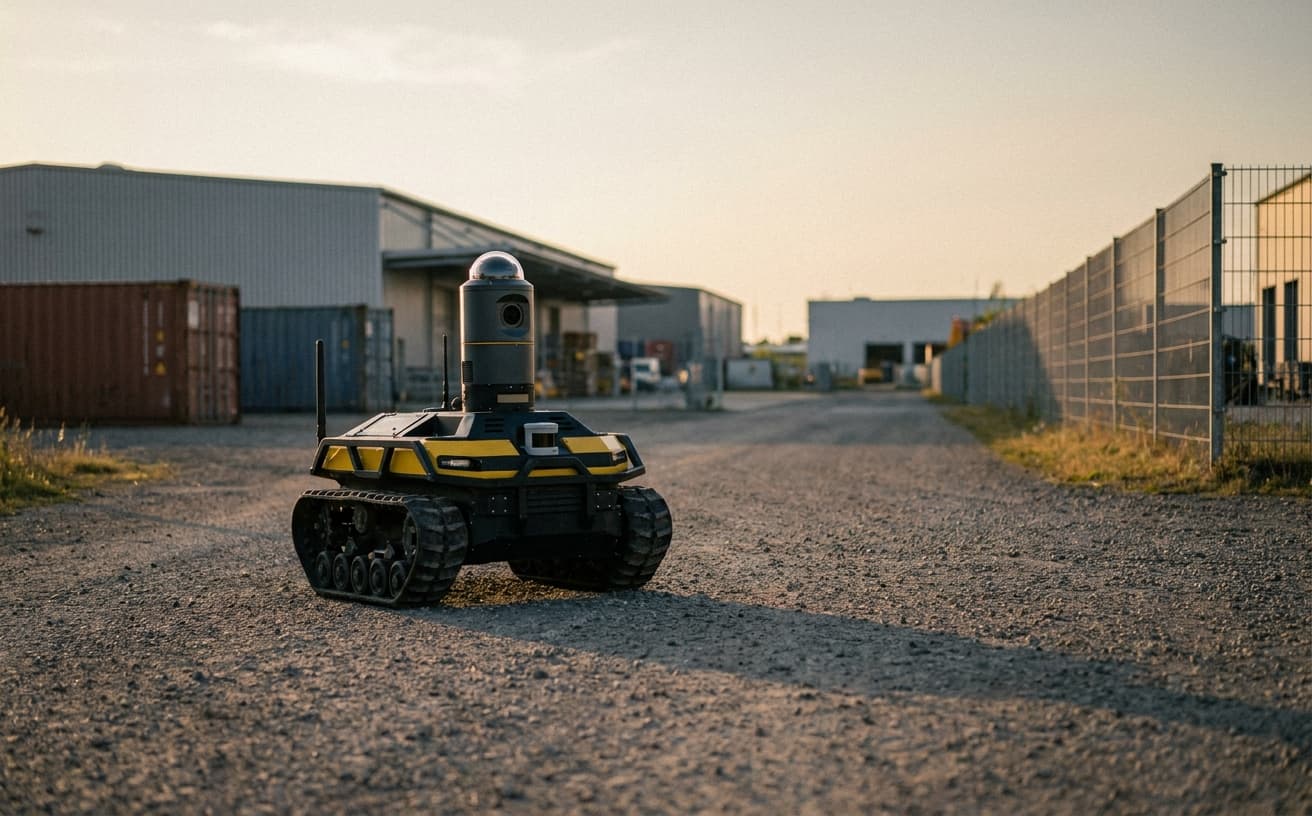
Saudi Arabia is not buying security robots. It is buying control over a perimeter that does not yet exist.
That distinction matters. A mature industrial nation places autonomous security on top of an established stack: fences that have stood for decades, guard forces with a generational memory, insurance contracts that have absorbed losses long enough to know where the leakage sits. Saudi Arabia is building the perimeter and the stack at the same time. Vision 2030 is not a modernisation programme in the European sense. It is the construction of an industrial base, a logistics network, a tourism sector and an urban geography that did not exist a decade ago. Security technology in this context is not an upgrade. It is part of the foundation.
The manufacturer's perspective on this market is therefore different from the perspective on Germany, Austria or Switzerland. The European customer asks how a security robot integrates with what is already there. The Saudi customer asks what is needed before the asset goes live. The first question is harder for the buyer. The second is harder for the supplier, because the answer must hold for twenty years, not for the next contract cycle.
The regulatory ground beneath the kingdom
The Saudi cybersecurity and physical security architecture rests on a small number of authorities whose decisions reach further than their published documents suggest. The National Cybersecurity Authority, established in 2017, issues the Essential Cybersecurity Controls, the Critical Systems Cybersecurity Controls and the Cloud Cybersecurity Controls. These are not advisory frameworks. They are mandatory for entities classified as critical, and the classification reaches into sectors that European operators would consider commercial. Petrochemicals, water, large-scale logistics, healthcare networks: all fall within scope.
Alongside the NCA stands the High Commission for Industrial Security, an entity originally built around Aramco facilities and now extended across the kingdom's industrial estate. HCIS publishes the Security Directives, which govern physical security at petrochemical sites, refineries, gas processing plants and the storage and transport infrastructure that connects them. The directives are detailed. They specify perimeter standards, intrusion detection requirements, command and control architectures, response time benchmarks and the documentation expected from any contractor operating within a site. A security robot deployed at a HCIS-governed facility does not enter as a piece of equipment. It enters as a component of a documented control regime.
Beyond NCA and HCIS, the regulatory environment is shaped by sector-specific authorities. The Communications, Space and Technology Commission governs the spectrum and connectivity layer that any networked security system depends on. The Saudi Data and Artificial Intelligence Authority oversees the use of AI in regulated contexts, including the kind of video analytics that sits inside modern autonomous security platforms. The Public Investment Fund, while not a regulator in the technical sense, sets the procurement direction for the giga-projects through its ownership structures, which means that what PIF expects becomes what the market delivers.
International frameworks operate in parallel rather than in opposition. NIST CSF 2.0 and NIST 800-53 inform the cybersecurity controls without dictating them. IEC 62443 applies to industrial control system security at any facility where operational technology and security technology converge. ISO 27001 is widely referenced as a baseline for information security management. The Saudi authorities have not adopted these standards wholesale. They have written their own, calibrated to a kingdom that intends to be a regulator in its own right, not a follower of European or American conventions.
NEOM and the industrial reality behind the renderings
NEOM is the most-discussed and least-understood element of Vision 2030. The renderings of The Line, Oxagon and Trojena have done as much to obscure the project as to communicate it. Behind the visualisations sits a more sober reality: a region the size of Belgium under active construction, with industrial zones, logistics corridors, energy infrastructure and worker accommodation that already exist on the ground. The security challenge at NEOM is not the future city. It is the current construction site.
A construction site of this scale does not behave like a European Großbaustelle. The perimeter measures hundreds of kilometres. The workforce numbers in the tens of thousands. The supply chain runs through ports, airports and overland routes that themselves require protection. Material values per square kilometre are extraordinary, because the build is happening across categories simultaneously: power generation, water treatment, road and rail, residential, industrial. A theft pattern that would be statistically noticeable in Germany is invisible here, lost in the volume of legitimate activity. Vandalism, sabotage, insider diversion and organised theft all coexist, and the conventional answer of more guards on more shifts collides with a labour market that is itself being constructed.
Autonomous security fits into this environment because it solves the scaling problem that human-only security cannot solve. A single operator can supervise multiple robotic platforms across kilometres of perimeter. A mobile video tower can be deployed in hours to a sector that did not exist last week. AI-supported video analytics can filter the noise of legitimate movement and surface the events that warrant a response. None of this replaces the security officer. It changes the ratio. One officer covering ten positions through technology delivers a coverage that one officer covering one position cannot, and the alternative, ten officers covering ten positions, is unavailable at the speed NEOM requires.
The manufacturer who understands this does not arrive with a product catalogue. The manufacturer arrives with a deployment logic that accepts the construction reality: rapid installation without specialist tooling, autonomous power, robust hardware that survives heat, dust and the rough handling of a live site, and software that operates with or without continuous connectivity. The book BOSWAU + KNAUER. From Building to Security Technology describes this logic in detail, because it was developed on European construction sites under conditions that, while milder than the Tabuk desert, taught the same lessons about robustness, autonomy and operator clarity.
Which sectors actually deploy
Vision 2030 distributes investment across sectors that vary widely in their security maturity and their appetite for autonomous platforms. Identifying which sectors will deploy first and at scale is a matter of reading the industrial logic, not the marketing material.
Hydrocarbons remain the foundation. Aramco facilities operate under HCIS at a level of security sophistication that few global operators match. The introduction of autonomous platforms here is not a question of capability acceptance, it is a question of integration into existing command and control architectures that already function. The sector is sophisticated enough to specify what it wants and demanding enough to reject what does not perform. Robotic patrols, perimeter analytics and integrated sensor platforms are operationally relevant, and procurement follows extended qualification cycles measured in years, not quarters.
Logistics and ports are the second sector. Saudi Arabia's ambition to become a global logistics hub depends on the Red Sea ports, the King Abdullah Port and the new corridors connecting them to interior consumption and to NEOM's Oxagon. These facilities run on cargo throughput that does not tolerate dwell time, and security incidents translate directly into commercial loss. Autonomous security here serves the same function it serves at European logistics centres, scaled up: continuous perimeter awareness, intelligent video analytics, rapid deployment to incident locations. The procurement logic is closer to commercial benchmarks, which makes the sector more accessible to suppliers from outside the kingdom.
Tourism and heritage form the third sector. The Red Sea Project, AlUla and the entertainment destinations built around Riyadh require a security posture that is visible without being intrusive. Autonomous platforms can patrol perimeters and parking areas, support crowd management at scheduled events and provide documented incident response without the staffing footprint that would otherwise be required. ASIS International guidance on event and venue security informs the approach, although Saudi authorities apply their own overlay.
Industrial cities and the manufacturing zones administered through the Saudi Authority for Industrial Cities and Technology Zones represent the fourth sector. These are sites where European industrial security practice is most directly transferable. The reference frameworks, IEC 62443 for the OT layer, ISO 27001 for the information security management system, are familiar to the international suppliers building plants there, and security robotics enters as part of the standard package rather than as a special procurement.
Who decides, who certifies, who pays
The Saudi procurement environment rewards suppliers who understand the decision architecture and punishes those who do not. The decision to deploy autonomous security at a NEOM construction zone, an industrial city or an Aramco facility is not made by a single buyer. It is made by a sequence of approvals that begin with the operational owner, pass through the security organisation, are reviewed by HCIS or the equivalent sector authority, and are validated against NCA controls if the system touches networked infrastructure. A supplier who solves only for the operational owner discovers the other approvals later, often after the contract has been signed and before the system has been deployed.
Certification is the gating function. A robot, a mobile tower or a video analytics platform cannot be deployed at a HCIS-governed site without demonstrating compliance with the relevant directives. The compliance demonstration is documentary and operational. The documentation must show the supply chain, the cybersecurity posture, the data residency arrangements, the integration architecture and the lifecycle support plan. The operational demonstration may include site acceptance testing under conditions that the Saudi authority specifies, not the supplier. International certifications, BSI guidance, GDV recommendations, ISO 27001, IEC 62443, support the case but do not replace the local approval. NICB-style asset tracking conventions are useful where they map to Saudi customs and logistics records, but the manufacturer should not assume European or American frameworks are accepted by default.
Payment structures reflect the project finance of the giga-projects. PIF-controlled vehicles operate with budgets that are substantial but disciplined, and payment cycles can be long. International suppliers who enter without local partnership often discover that the working capital requirements exceed what their balance sheet supports. The pattern that works is partnership with a Saudi entity that holds the commercial relationship while the foreign supplier holds the technology relationship. This structure is not unique to Saudi Arabia, but the kingdom enforces it more consistently than markets where it is optional.
CISA-style threat intelligence sharing, while not a Saudi institution, finds its analogue in the information exchanges run by the NCA and the sector authorities. A supplier who participates constructively in these exchanges accumulates a reputation that translates into procurement preference over time. The market is smaller, in decision-making terms, than its geographic scale suggests. The same names recur across procurement committees, and the same suppliers earn or lose trust across multiple projects in parallel.
What holds
Saudi Arabia represents an opportunity that is real, large and difficult. It is real because Vision 2030 has moved past the announcement phase into construction, and the security requirement is operational, not theoretical. It is large because the volume of perimeter, the scale of industrial assets and the pace of new asset commissioning exceed what any single supplier can address. It is difficult because the regulatory architecture is unfamiliar to European operators, the procurement logic rewards partnership over solo entry, and the operational conditions stress hardware and software in ways that a manufacturer trained on European construction sites must respect before claiming readiness.
The manufacturers who will deploy at scale in Saudi Arabia over the coming years are not those with the largest marketing presence. They are those who have built systems that survive the engineering reality, who understand that NCA and HCIS approval is non-negotiable, and who arrive in the kingdom with a partnership posture rather than an export posture. Autonomous security robotics has a place in this market because the scaling problem cannot be solved otherwise. It does not have a guaranteed place, because the kingdom is selective about what it accepts.
For operators considering whether and how to engage, the right starting point is a confidential conversation about the specific facility, sector and timeline involved. The Path I sixty-minute discussion is structured precisely for this purpose: to translate a Saudi opportunity into an honest assessment of whether the supplier and the requirement match, before either side commits resources that a later mismatch would waste.
Frequently asked questions
What does the Saudi NCA require?
The National Cybersecurity Authority requires compliance with its Essential Cybersecurity Controls for all government and critical entities, with the Critical Systems Cybersecurity Controls for systems classified as critical, and with the Cloud Cybersecurity Controls where cloud services are involved. For autonomous security platforms, the practical implications include documented supply chain integrity, defined data residency, hardened network architecture, controlled remote access and demonstrable incident response procedures. The controls reference international frameworks such as NIST CSF and ISO 27001 but apply Saudi-specific overlays. Compliance is mandatory, not advisory, and procurement at critical entities will not proceed without it.
How does HCIS govern industrial sites?
The High Commission for Industrial Security governs physical security at petrochemical, refining, gas and related industrial facilities through its Security Directives. These directives specify perimeter standards, intrusion detection requirements, command and control architectures, response time benchmarks and contractor documentation. HCIS approval is required before any security system, including autonomous platforms, can be deployed at a governed site. The approval process is documentary and operational, often including site acceptance testing under HCIS-specified conditions. The directives draw on IEC 62443 and ASIS International practice but are written for Saudi operational reality and enforced by Saudi authority.
Which sectors in Vision 2030 prioritize robotics?
Four sectors lead in operational deployment of autonomous security. Hydrocarbons, through Aramco and affiliated entities, deploy robotics and integrated sensor platforms at facilities operating under HCIS. Logistics and ports, including the Red Sea ports and Oxagon at NEOM, deploy autonomous perimeter and analytics platforms to support throughput-driven operations. Tourism and heritage destinations, including the Red Sea Project and AlUla, deploy robotics for visible perimeter coverage without intrusive staffing. Industrial cities administered through MODON and similar authorities deploy robotics as part of standard facility security. Construction security across NEOM and the giga-projects represents a fifth and growing category.
Who certifies a robot for Saudi deployment?
Certification depends on the deployment context. For sites under HCIS authority, HCIS itself approves through its directives compliance process. For systems touching networked infrastructure at critical entities, the National Cybersecurity Authority approves against its controls. For AI components, the Saudi Data and Artificial Intelligence Authority may apply additional review. Spectrum and connectivity elements fall under the Communications, Space and Technology Commission. International certifications, ISO 27001, IEC 62443, BSI guidance, support the case but do not substitute for Saudi approval. The practical certification path runs through a Saudi partner who manages the regulatory interface while the manufacturer supplies the technology and documentation.
Related topics
- Who Is Liable When a Security Robot Misses an Incident
- Security Robots For Sale vs Rental: When CapEx Actually Wins
- Security Robot Companies 2026: The Twelve Real Vendors
- Security Robot vs Human Guard: The Honest Five-Year Math
- Extreme Heat & Security Robots in the Gulf: 55C
- Is a Security Robot ROI Positive in Under Two Years?
Take the next step: See prices & ROI · Explore the products · Send a no-obligation request. BOSWAU + KNAUER – direct from the factory in Filderstadt, reply within 5 working days.
About the author
Dr. Raphael Nagel (LL.M.) is founding partner of Tactical Management. He acquires and restructures industrial businesses in demanding market environments and writes on capital, geopolitics, and technological transformation. raphaelnagel.com
More reading
Since 1892.
The firm is reached at boswau-knauer.de or +49 177 2266267.