
Blog
Extreme Heat & Security Robots in the Gulf: 55C
Sustained 50-55C operating envelopes, sand intrusion, IEC 60529 IP-X testing. The Gulf is not Europe with sun.

Dr. Raphael Nagel
November 23, 2025
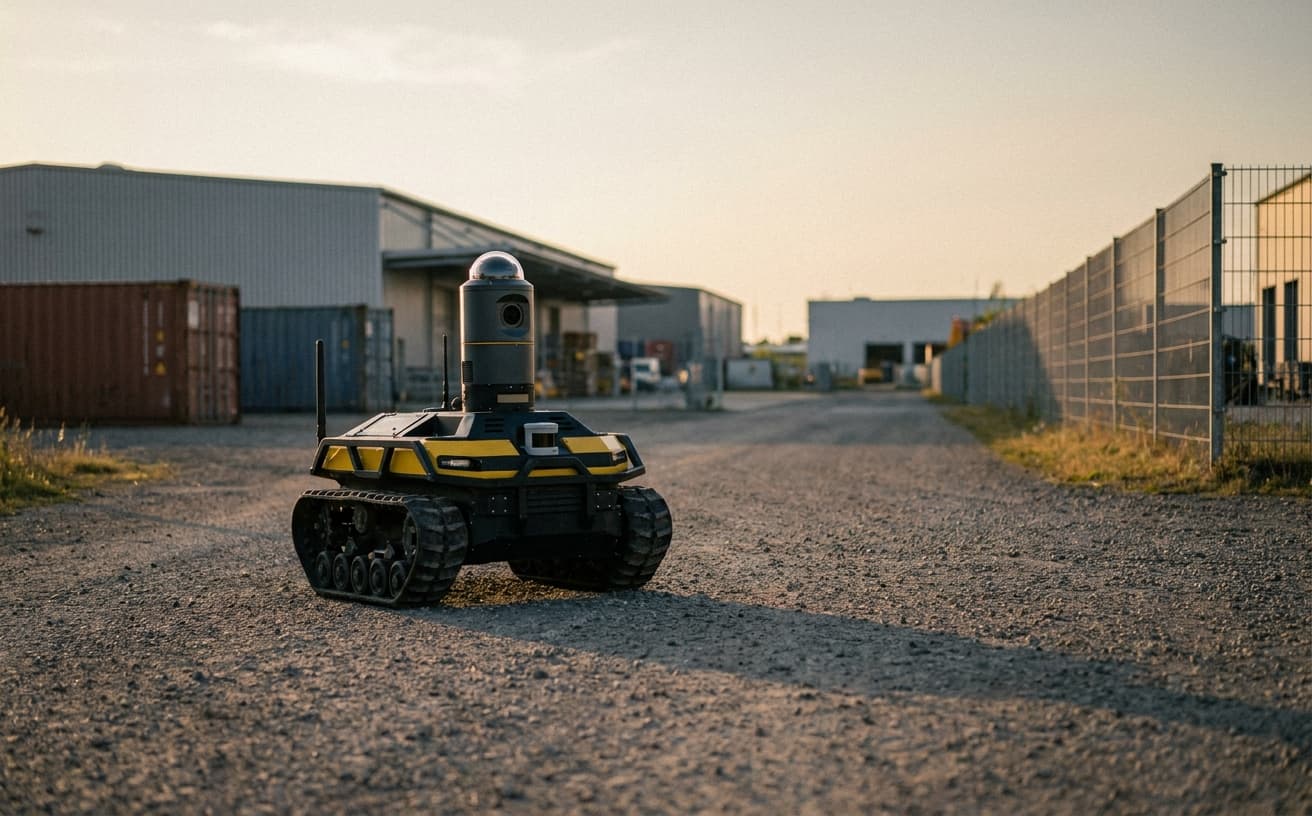
The Gulf is not Europe with sun. It is a different operating regime, and most security robotics sold into the region were never designed for it.
That sentence reads as a marketing line until one looks at the datasheets. A platform rated for "operation up to 45°C ambient" is not failing the buyer when it shuts down at 52°C in Dubai in August. It is doing precisely what its engineers specified. The failure sits earlier, in the procurement conversation, where the operator did not insist on a thermal envelope that matched the site, and the vendor did not volunteer one. Boswau + Knauer encountered this gap during the Gulf engagements that followed the first European deployments, and the conclusions drove a series of hardware decisions that now shape the platform.
What follows is a manufacturer's view of what extreme heat actually does to a security robot in sustained operation, what the relevant standards say, what they fail to say, and where the gap between specification sheet and operational reality has cost operators more than they accounted for.
The thermal envelope nobody verifies
Most autonomous ground platforms in the security category are specified for ambient operating ranges between minus 10°C and plus 45°C. That envelope reflects the European testing tradition, where a continental summer rarely sustains above 38°C and the peak hours are short. The Gulf operating reality runs different parameters. Daytime ambients of 48 to 52°C are normal between May and September. Surface temperatures on asphalt and concrete reach 65 to 75°C during the same period. Inside a sealed enclosure exposed to direct sun, internal temperatures can climb 15 to 20°C above ambient within minutes if convective cooling is inadequate. A robot rated for 45°C ambient is, in practical terms, operating outside its specification for roughly four months of the year.
The consequences are not theoretical. Lithium-ion cells degrade rapidly above 45°C cell temperature, with calendar ageing accelerating non-linearly. A pack that delivers eight hundred full cycles at 25°C may deliver under three hundred at sustained 50°C ambient. Computational silicon throttles. The GPUs and edge inference modules that perform object classification reduce clock speeds to protect die temperature, which means detection latency grows. Image sensors produce more noise at elevated temperatures, which the analytics stack reads as movement, which produces false positives, which trains the operator to ignore the system. None of this appears in the procurement specification. All of it appears in the third month of summer.
The manufacturer's response is not to publish a higher headline number. It is to specify the envelope in three dimensions: ambient temperature, solar load in watts per square metre, and duty cycle. A platform certified for sustained operation at 50°C ambient under 1,000 W/m² solar load at 80 percent duty cycle is a different machine from one certified at 50°C in shade at 30 percent duty cycle, even if the headline figure is identical. The Gulf operator who reads only the headline number is reading a fiction. Boswau + Knauer publishes the three-dimensional envelope because the alternative is a warranty conversation in October.
What IEC 60529 actually tests
The IP rating system, defined in IEC 60529, is treated in the security industry as a complete answer to environmental robustness. It is not. The standard tests two things: ingress of solid foreign objects and ingress of water. It tests neither at sustained operating temperature, nor under the abrasive conditions that govern desert operation, nor for the duration that matches a year-round deployment.
IP65, the common specification, certifies dust-tight construction and protection against low-pressure water jets. The dust test uses talcum powder of defined particle size, circulated in a chamber for two to eight hours depending on the enclosure category. Gulf sand is not talcum powder. The particle size distribution in Arabian Peninsula aeolian sand ranges from under 50 micrometres in the fine fraction to over 500 micrometres in the coarse, and the silica content makes it abrasive in a way the test dust is not. Sustained exposure to wind-driven sand wears gasket surfaces, scours optical windows, and finds entry through cable glands that passed the laboratory test but were not designed for monsoon-season shamal events. IP65 is necessary. It is not sufficient.
The relevant supplementary frameworks are MIL-STD-810H, particularly method 510 for blowing dust and method 501 for high temperature, and IEC 62443 for the control system layer that sits on top of the hardware. ISO 27001 covers the information security dimension but says nothing about whether the platform survives August. The manufacturer who deploys into the Gulf without supplementary testing beyond IP65 is relying on a certification that was never designed for the conditions. Boswau + Knauer runs an internal protocol that combines IEC 60529 ingress testing with sustained thermal cycling at 55°C peak, fine-particulate exposure derived from collected site samples, and accelerated UV ageing on polymeric components. The protocol takes longer than the standard tests. It produces platforms that complete their second summer.
Sand intrusion and the gasket problem
Sand intrusion is the failure mode that operators describe in terms that sound colourful and prove to be precise. Sand gets everywhere. The mechanism is not single. It is the cumulative effect of three distinct physical processes that work on different time scales.
The first is direct ingress through wind-driven impact during high-velocity events. A shamal can sustain wind speeds of 60 to 80 kilometres per hour for periods of 24 to 72 hours, carrying particulate at densities that overwhelm filter stages designed for European conditions. The second is thermal cycling. Diurnal temperature swings of 25°C cause expansion and contraction of housings and gaskets, producing micro-gaps that admit fine particulate over months even when no single event would breach the seal. The third is gasket degradation under UV and ozone exposure. Standard nitrile and EPDM compounds lose elasticity in Gulf conditions within 18 to 30 months, well before the platform reaches end-of-life. A robot that was IP65 at delivery is IP54 at month thirty if the gaskets were specified to European standards.
The engineering response operates on each layer. Filtered intake paths with positive-pressure plenums prevent ingress on moving-air systems. Gaskets specified in fluorocarbon (FKM) or silicone compounds rated for sustained UV exposure replace the standard nitrile. Critical optical surfaces sit behind sacrificial windows that are replaceable in the field without breaking the main enclosure seal. Cable glands carry double sealing with internal strain relief that does not work itself loose under vibration. None of these are exotic engineering choices. They are deliberate specification decisions that add cost at manufacture and remove cost over the operating life. CISA's guidance on physical security for critical infrastructure assets, while focused on threat-driven design, converges on the same principle: the durability of the protective layer is the durability of the protection itself.
Batteries, thermal management, and the lithium problem
Lithium-ion chemistry is the limiting factor in Gulf deployment of mobile security platforms, and no software update will change that. The cell chemistries that deliver the energy density required for an eight-hour patrol cycle have a fundamental relationship with temperature that engineers can manage but cannot eliminate. Optimal operating temperature for NMC and LFP cells sits between 15 and 35°C. Above 45°C cell temperature, calendar ageing accelerates. Above 60°C, the risk of thermal runaway becomes a design consideration that demands active mitigation rather than passive tolerance.
A security robot operating at 50°C ambient with internal heat generation from motors, drives, and computation can reach 65 to 70°C inside the battery compartment without active thermal management. Passive cooling is not adequate. The platforms that operate reliably in Gulf conditions use one of three approaches. The first is liquid cooling of the battery pack, with a closed-loop coolant circuit that maintains cell temperature within a defined band regardless of ambient. The second is forced-air cooling with filtered intake and exhaust, which is lighter and simpler but less effective at sustained high ambients. The third is duty-cycle management, where the platform reduces operating intensity during peak heat hours and recovers thermal margin during cooler windows. In practice, robust deployments combine all three.
The selection between LFP (lithium iron phosphate) and NMC (nickel manganese cobalt) chemistries also matters in this context. LFP has lower energy density, which means a heavier platform for the same range, but it tolerates elevated temperatures considerably better and is intrinsically safer in thermal runaway scenarios. For Gulf deployment, the energy density trade is usually worth taking. Boswau + Knauer specifies LFP for platforms intended for sustained tropical operation, and the operators who absorbed the slightly higher initial mass for the lower replacement rate are, three years later, the ones who are not running pack-replacement cycles. The book BOSWAU + KNAUER. From Building to Security Technology addresses the underlying logic: components selected for the operating environment outlast components selected for the datasheet.
MTBF degradation: what fails first and why it matters
Mean time between failures is the metric the procurement department wants and the engineering department mistrusts, because the figure that appears on the proposal is almost always a composite calculated under laboratory conditions that the deployment will not reproduce. The useful question is not what the headline MTBF says. It is which subsystems degrade first in Gulf operation, and how the degradation curve looks across the operating life.
The empirical sequence, drawn from sustained deployment observation, runs as follows. Optical surfaces degrade first, through abrasion and accumulated deposit, with measurable image quality loss appearing within four to eight months on platforms without sacrificial windows or active cleaning. Gaskets and seals follow, with material property loss accumulating into ingress breaches between months 18 and 36 depending on compound selection. Bearings and mechanical actuators show wear patterns at the 24 to 48 month mark, driven by particulate contamination of lubricants rather than load cycling. Battery capacity declines on a curve that depends on chemistry and thermal management but typically reaches the 80 percent replacement threshold between 1,500 and 2,500 operating hours under Gulf conditions, compared to 3,000 to 4,000 hours in temperate deployment. Electronics, in contrast, often outlast the mechanical components if thermal management is adequate, because silicon failures tend to be either early-life infant mortality or end-of-life wear-out, with a long flat middle.
The operational consequence is that an MTBF figure quoted as a single number misleads. A platform with an MTBF of 8,000 hours in temperate conditions may have an effective MTBF of 3,500 hours in the Gulf, but the failure modes are not random across that interval. They cluster around the components listed above, in the sequence listed. Operators who understand this can design their maintenance intervals around the actual degradation curve rather than the average. Vendors who understand this can publish service intervals that match the environment rather than the catalogue. The NIST CSF 2.0 framing of resilience as a continuous process rather than a state captures the right posture: the platform that maintains its function over time is the one whose degradation is anticipated and managed, not the one whose datasheet promised that degradation would not occur.
What this means for procurement and operation
The operator who is specifying a security robot for Gulf deployment has a small set of questions that should be answered in writing before the order is placed. What is the sustained ambient operating temperature, in shade and in direct solar load? What is the ingress protection rating, and against what particulate distribution was it tested? What is the battery chemistry, what is the thermal management approach, and what is the expected capacity retention curve under the actual deployment profile? What are the field-replaceable wear components, and what are the service intervals against the relevant environmental factors? What does the vendor commit to in writing regarding warranty coverage under the actual operating envelope, not the laboratory envelope?
These questions are uncomfortable because they expose the gap between marketing and engineering on most platforms in the market. They are not optional. The operator who declines to ask them is purchasing a fiction, and the fiction will be exposed by the second summer at the latest. ASIS International guidance on operational security technology, GDV loss-prevention frameworks, and the NICB observations on equipment-related risk all converge on the same principle: the asset that fails in the field at the moment it is needed has negative value, because it consumed budget and produced no protection. A robot that is offline during a shamal event because its thermal management is inadequate is, at that moment, worse than no robot at all, because budget was spent on the assumption of coverage that did not materialise.
The procurement conversation that protects against this outcome takes longer than the standard purchase cycle. It involves engineering review, not just commercial review. It involves site survey, not just specification matching. It involves, in the model Boswau + Knauer operates, a structured pilot of ninety days in which the platform demonstrates sustained operation under the actual environmental profile before the larger commitment is made. This is Path III in the framework set out in the book, and for Gulf deployment it is the path that consistently produces fleets that complete their planned operating life. The alternative, which is procurement based on datasheet matching followed by hope, has a track record that the operators who have walked it can recite.
What holds
The Gulf operating environment is not a marginal extension of European conditions. It is a distinct regime with thermal, particulate, and ageing parameters that demand specific engineering responses. Platforms specified for temperate operation will deploy in the Gulf and will produce a year of acceptable performance, and they will then degrade on a curve that the operator did not expect because the curve was not in the specification.
The manufacturer's responsibility is to publish the operating envelope honestly, in three dimensions, and to build to that envelope rather than to the headline number. The operator's responsibility is to insist on the honest envelope and to budget for the maintenance intervals that the actual environment requires. The shared responsibility is to test under conditions that approximate the deployment before the commitment is made.
For operators considering Gulf deployment of autonomous security platforms, the Path II audit, three to five days on site, produces the environmental profile that allows specification to be matched to reality. For operators already deployed and observing degradation patterns they did not expect, the Path I confidential conversation establishes whether the current platform can be operated more carefully or whether the next refresh cycle requires a different specification. Both conversations are available. Neither requires a purchase commitment to begin.
Frequently asked questions
What heat envelope is realistic?
For sustained Gulf operation, the realistic ambient envelope sits between 50 and 55°C peak with solar load to 1,000 W/m², for platforms specified and built for that condition. Platforms rated for 45°C ambient will operate above that figure but with accelerated degradation across batteries, optics, and seals. The honest specification distinguishes between survival temperature, which is the limit above which damage occurs, and sustained operating temperature, which is the band within which the platform delivers full duty cycle without accelerated wear. Operators should request both figures and the underlying test conditions in writing.
How is sand intrusion handled?
Sand intrusion is managed through layered engineering rather than a single ingress rating. The layers include filtered positive-pressure intake on moving-air systems, UV-stable gasket compounds in FKM or silicone rather than standard nitrile, sacrificial optical windows that are field-replaceable without breaking the main enclosure seal, double-sealed cable glands with mechanical strain relief, and service intervals that account for gasket ageing on the timeline that Gulf conditions produce. IP65 is the starting specification, not the complete answer, and supplementary testing under MIL-STD-810H method 510 with site-representative particulate is the practical verification.
How are batteries protected?
Battery protection in Gulf deployment combines chemistry selection, thermal management, and duty-cycle design. LFP chemistry tolerates elevated temperatures better than NMC and is the preferred choice for sustained tropical operation despite lower energy density. Thermal management uses active liquid or forced-air cooling rather than passive dissipation, maintaining cell temperature within the 15 to 35°C band where calendar ageing is acceptable. Duty-cycle scheduling reduces operating intensity during the hottest hours of the day, allowing thermal recovery. The combination extends usable pack life from the 1,500-hour range to the 2,500 to 3,500-hour range under Gulf conditions.
What MTBF degrades first?
The empirical sequence of degradation in sustained Gulf operation runs from optical surfaces in the first six to eight months, through gaskets and seals between months 18 and 36, to mechanical actuators and bearings between months 24 and 48, with batteries reaching replacement thresholds between 1,500 and 2,500 operating hours. Electronics, given adequate thermal management, often outlast the mechanical and optical components. The composite MTBF figure on the datasheet masks this sequence. Effective maintenance planning addresses each component against its actual degradation curve rather than the average, which is the figure quoted but not the figure that fails.
Related topics
- Security Robots in Qatar: MOI Standards & Legacy
- Security Robots at DEWA: Utility Perimeter
- UK Data Centre Corridor: Slough, Docklands & West London
- Security Robot vs Human Guard: The Honest Five-Year Math
- Security Robots in Saudi Arabia: Vision 2030 & NEOM
Take the next step: See prices & ROI · Explore the products · Send a no-obligation request. BOSWAU + KNAUER – direct from the factory in Filderstadt, reply within 5 working days.
About the author
Dr. Raphael Nagel (LL.M.) is founding partner of Tactical Management. He acquires and restructures industrial businesses in demanding market environments and writes on capital, geopolitics, and technological transformation. raphaelnagel.com
More reading
Since 1892.
The firm is reached at boswau-knauer.de or +49 177 2266267.