
Blog
Surveillance Trailer Rental: The US Market by Zip-Code-Tier
US mobile surveillance trailer pricing, broken down by metro tier. Why Manhattan rates differ from Houston rates differ from a Wyoming oil yard. The honest map.

Dr. Raphael Nagel
March 12, 2025
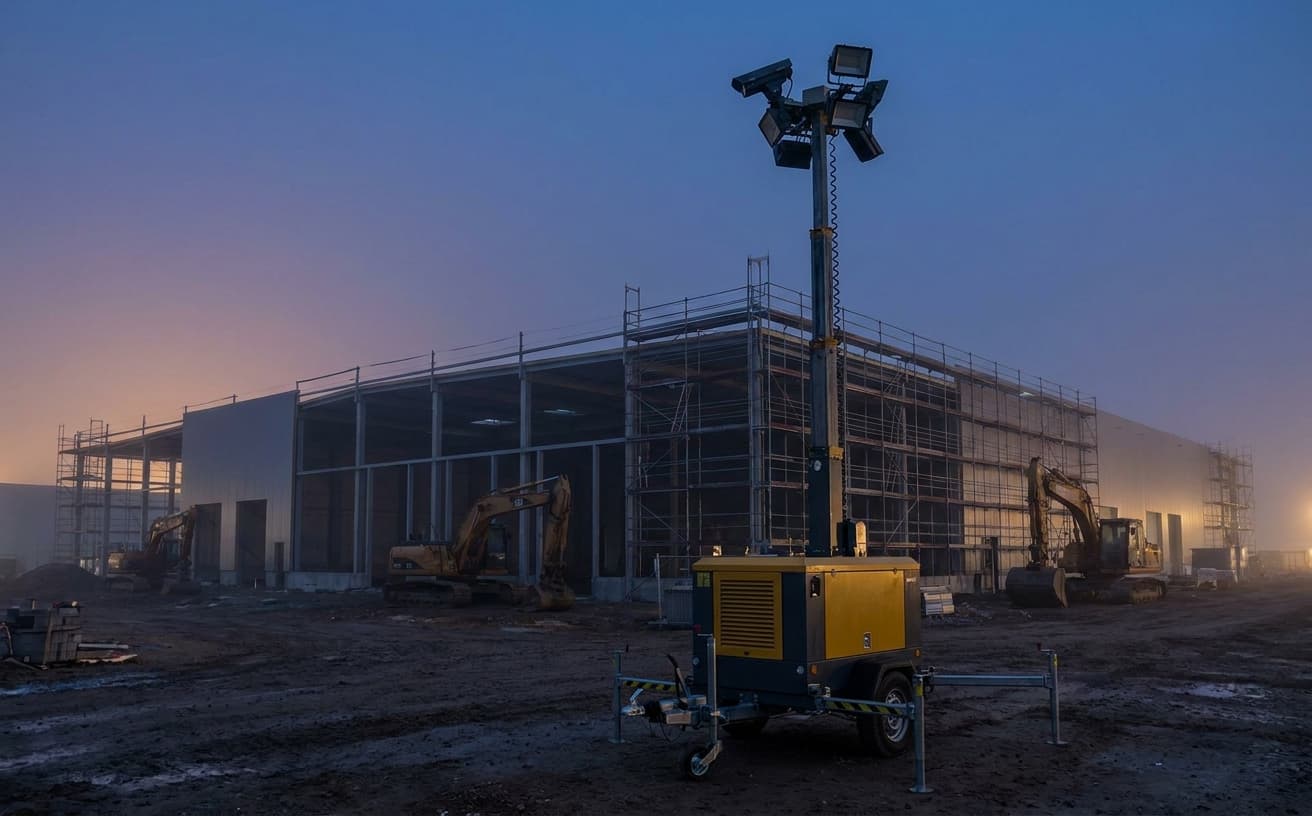
A surveillance trailer rental quote in the United States is not a price. It is a composite of labor cost, fuel logistics, response time, insurance posture, and the willingness of the local market to pay for what the customer thinks security should look like.
The number on the invoice obscures more than it reveals. A general contractor in Midtown Manhattan and an oilfield operator in Converse County, Wyoming both ask the same question, "what does a surveillance trailer cost per month," and both receive answers that diverge by a factor of three to four. Neither customer is being mistreated. The answers are correct for their respective markets. What is missing in most procurement conversations is a clean framework for understanding why. The framework is geographic, but the geography that matters is not state lines. It is zip-code tier, drive-time radius from the nearest service depot, and the underlying loss profile of the asset being protected.
The Zip-Code Tier as a Pricing Variable
The American surveillance trailer market does not price by state. It prices by zip-code tier, because the cost structure of delivering a trailer to a site, swapping batteries or generators, refueling, and responding to alarms is dominated by drive time and labor density. A trailer parked in the financial district of New York costs the operator something fundamentally different to service than the same trailer parked on a pad site in Laramie County. The hardware is identical. The economics are not.
Tier one zip codes cover the dense urban cores of New York, San Francisco, Boston, Washington DC, and Los Angeles. Monthly rental rates in these zip codes routinely sit between 3,800 and 6,500 US dollars. The premium reflects parking permits, escort requirements, union labor for placement in certain jurisdictions, restricted delivery windows, and the simple fact that a service technician in Manhattan bills at a rate that has nothing to do with what the same technician would bill in Tulsa. Tier two zip codes cover the suburban rings around major metros, the secondary cities of the Sun Belt, and the established industrial corridors of the Midwest. Rates here run from 2,400 to 3,800 US dollars per month. This is the largest segment of the market by trailer count, and it is also the segment in which competition is most intense. A construction site in suburban Atlanta, a logistics yard outside Indianapolis, a multifamily build in Phoenix, all sit in tier two and all have multiple credible vendors within a ninety-minute drive.
Tier three zip codes cover the outer commuter rings, small metropolitan areas, and the agricultural belts that surround them. Rates fall between 1,800 and 2,800 US dollars per month. Tier four zip codes are the rural and frontier markets, the oilfields of the Permian and the Bakken, the wind farms of Oklahoma and the Texas Panhandle, the remote solar installations of Nevada. Rates here become unpredictable. The headline number may read 1,600 dollars per month, but the deployment fee can add another 1,200, and the demobilization fee adds another 800. The total cost of a four-month deployment in tier four can exceed the cost of the same trailer in tier two, despite the lower headline rate. Procurement teams that compare only the monthly rate miss the structure entirely.
What Drives the Manhattan Premium
A trailer placed in a tier one zip code carries cost components that do not exist in tier four. Parking permits in Manhattan, San Francisco, and central Boston require lead time and are not free. In some jurisdictions, the trailer cannot be placed on a public right-of-way at all, which means the asset sits on private property, often at a per-square-foot rate that the security vendor passes through to the customer. Escort requirements during placement, particularly in financial districts and government adjacency zones, add labor hours that show up nowhere on a standard quote. Union labor in certain construction markets requires that placement and removal be conducted by qualified personnel from a specific local, which can add 600 to 1,000 dollars per deployment cycle.
Service economics in tier one are inverted relative to tier four. A technician driving from a Queens depot to a Midtown jobsite consumes ninety minutes of paid time to cover six miles. The same technician in West Texas covers ninety miles in the same ninety minutes. The hourly labor rate in tier one is also two to three times higher than in tier four, which compounds the effect. Battery swaps, generator refueling, camera realignment after a windstorm, lens cleaning after a dust event, all consume labor, and the labor in tier one is structurally expensive.
Insurance is the third driver. A surveillance trailer placed in a high-crime tier one zip code carries a different loss profile than the same trailer placed in a low-crime tier three zip code. Theft of the trailer itself, vandalism, and the cost of responding to false alarms generated by urban density all push insurance costs higher. NICB data on commercial equipment theft in metropolitan statistical areas consistently shows the urban cores with elevated frequency, and that frequency is priced into the rental. Customers who object to the Manhattan premium are objecting to a structure that has been audited by underwriters who do not negotiate on sentiment.
The Houston Mid-Tier and Why It Anchors the National Market
Houston, Dallas-Fort Worth, Atlanta, Phoenix, and the Inland Empire form the backbone of the American surveillance trailer market. These metros combine high construction volume, significant logistics activity, large oil and gas service sectors, and labor markets that price competitively. A surveillance trailer in suburban Houston rents for between 2,400 and 3,200 US dollars per month, with the median sitting close to 2,750. This is the price that national procurement teams reference when they benchmark vendors, and it is the price against which tier one and tier four quotes are measured.
The Houston mid-tier works because the cost structure is balanced. Labor is available at reasonable rates. Drive times from depot to site are typically under sixty minutes. Permitting is straightforward in most municipalities. Insurance is moderate. The customer base is sophisticated enough to understand what a trailer does and what it does not do, which reduces the friction cost of educating buyers. Multiple vendors compete in each metro, which keeps margins disciplined. The result is a price that reflects the underlying economics of the asset and the service, with neither the urban premium nor the rural surcharge.
What customers in the mid-tier should understand is that the price they pay subsidizes the price discovery for the rest of the market. Vendors use Houston-area economics to calibrate their pricing models, and they extrapolate from there. A vendor entering a new tier four market for the first time prices off the mid-tier benchmark plus a deployment premium that covers the unknown costs of operating without an established service depot. A vendor entering a tier one market prices off the mid-tier benchmark plus the documented incremental costs of urban operations. Either way, the mid-tier is the anchor, and the customer in suburban Houston is paying something close to the true cost of the service, neither subsidized nor surcharged.
Tier Four Economics: The Wyoming Oil Yard
A surveillance trailer deployed to a remote oil yard in Wyoming, the Permian Basin in West Texas, or the Bakken in North Dakota operates under a different economic regime. The headline monthly rate may appear attractive, often in the range of 1,600 to 2,200 US dollars. The deployment and demobilization fees, however, frequently exceed 1,000 dollars each, and on truly remote sites can reach 2,500 dollars per cycle. Fuel surcharges for generator-equipped trailers are higher because diesel must be delivered to sites where the nearest commercial fuel stop is forty miles away. Service response times are longer because the technician may be driving four hours to reach the site, which means that a routine battery swap consumes a full day of labor.
Loss profiles in tier four are different. The threats are not opportunistic urban theft but organized copper and equipment theft conducted by crews who travel to the site with their own tools and transport. ASIS International field reports and industry analyses from the past several years have documented the rise of organized theft rings targeting oilfield service equipment, copper grounding systems, and battery banks at remote installations. The surveillance trailer in this environment is not a deterrent against the casual passerby. It is a documentation and response trigger against a crew that has planned the visit. The pricing reflects this reality. Customers who deploy trailers in tier four are typically protecting assets worth multiples of the trailer rental cost, and the math holds even at the higher total cost of ownership.
The other variable in tier four is connectivity. Cellular coverage in remote oilfields is unreliable, which means that some sites require satellite uplink hardware, additional antenna infrastructure, or signal repeaters. These additions can add 400 to 800 dollars per month to the rental cost, and they are non-negotiable on sites where the cellular signal will not support continuous video upload. A customer comparing a tier two quote to a tier four quote without accounting for connectivity infrastructure is comparing two different products. The framework laid out in BOSWAU + KNAUER. From Building to Security Technology, which insists that a security system must be evaluated by what remains under operating conditions rather than by what appears on a datasheet, applies directly to this category of decision.
What Is Actually Included in the Monthly Rate
The single largest source of procurement disputes in the surveillance trailer market is the gap between what the customer thought the monthly rate covered and what the vendor's contract actually delivers. Most monthly rates include the trailer itself, the camera array, the recording infrastructure, the cellular data plan up to a defined ceiling, and a limited number of remote monitoring events per month. Most monthly rates do not include deployment to the site, demobilization from the site, fuel for generator-equipped units, battery replacements beyond normal wear, repairs from vandalism or weather damage, service calls outside of standard business hours, false alarm fees imposed by local police departments, or live monitoring by a UL-listed central station.
The customer who reads the contract carefully discovers that the 2,500 dollar monthly rate becomes a 3,400 dollar effective rate once deployment is amortized, fuel is included, and a central station monitoring agreement is layered on. This is not deceptive pricing in most cases. It is the structure of a market in which the base service and the optional services are unbundled to allow customers to configure what they need. The problem is that customers often configure what they think they need based on the sales conversation, only to discover during operation that they needed more.
The NIST Cybersecurity Framework 2.0 emphasizes the importance of understanding what an asset does and does not do as part of the identify function, and this principle applies to surveillance trailers as much as to network infrastructure. A trailer that records video to local storage is a different product than a trailer that streams video to a monitored central station, and both are different from a trailer with on-board analytics that classify events and trigger live operator review. The price differential between these configurations runs from 600 to 1,800 dollars per month. Customers who specify the wrong configuration pay either for capability they do not use or for outcomes they do not receive.
Rental Duration and the Pricing Curve
The pricing curve for surveillance trailer rental in the United States is non-linear with respect to duration. Short rentals, defined as fewer than thirty days, carry a premium that can run 40 to 80 percent above the standard monthly rate when annualized. The premium reflects the fixed cost of deployment and demobilization, which the vendor must amortize over a shorter revenue period. A trailer rented for two weeks for an event security application in tier two might invoice at 2,400 dollars for the period, which is higher than half of the monthly rate.
Standard monthly rentals, defined as one to six months, reflect the prices discussed in the tier analysis above. This is the segment in which most construction site applications sit, and it is the segment in which vendors compete most directly on price. Quarterly and semi-annual commitments often unlock a 5 to 10 percent discount off the monthly rate, particularly in tier two and tier three markets where vendors are willing to trade margin for utilization.
Long-term rentals, defined as twelve months or more, change the conversation. At twelve months, the customer is approaching the depreciation crossover point at which purchasing a trailer outright becomes economically rational. Vendors respond by offering rental-to-own structures, deeper discounts on the monthly rate, or bundled service agreements that include hardware refresh cycles. The customer who commits to twenty-four or thirty-six months at a single site is essentially financing a piece of capital equipment through the rental structure, and the pricing reflects that economic reality. CISA guidance on physical security infrastructure, which encourages organizations to plan for asset lifecycle costs rather than period-by-period rental decisions, applies here. The trailer is not a consumable. It is a depreciating asset with a maintenance schedule, and the pricing should be analyzed as such.
What Holds
The honest map of US surveillance trailer rental pricing is geographic, but the geography is not the one most procurement teams use. It is a map of labor density, drive time, insurance posture, and threat profile. Tier one zip codes price at 3,800 to 6,500 dollars per month. Tier two zip codes price at 2,400 to 3,800 dollars per month and anchor the national market. Tier three zip codes price at 1,800 to 2,800 dollars per month. Tier four zip codes carry low headline rates but elevated deployment, fuel, and connectivity costs that often push total cost of ownership above tier two levels.
The customer who understands this map can negotiate from a defensible position. The customer who does not is negotiating against a vendor who does, which is rarely a productive conversation. Pricing transparency does not exist in this market because the underlying economics vary too much by location, duration, and configuration. The closest substitute for transparency is a framework, and the zip-code tier is the framework that holds up under scrutiny.
Operators who want to validate their current pricing or pressure-test a proposed deployment can engage through Path I, a sixty-minute confidential conversation in which a current quote is examined against the tier benchmarks and the configuration is checked against the actual operational need. For larger portfolios spanning multiple sites and multiple tiers, Path II, the three to five day audit, produces a written analysis of the existing posture, the implied cost per protected asset, and the optimization paths available. Both routes deliver a defensible position before the next renewal cycle begins.
Frequently asked questions
What does a surveillance trailer cost in the US?
Monthly rental rates range from 1,600 to 6,500 US dollars depending on zip-code tier and configuration. Tier one urban cores price at 3,800 to 6,500 dollars. Tier two suburban and secondary metros, which include most US construction markets, price at 2,400 to 3,800 dollars. Tier three smaller metros price at 1,800 to 2,800 dollars. Tier four rural and frontier markets show low headline rates but high deployment and fuel costs. The headline rate is not the total cost. Deployment, demobilization, fuel, connectivity, and monitoring services add 15 to 35 percent in most cases.
How does cost vary by region?
Regional variation tracks labor density and drive time more than state borders. A trailer in Manhattan costs roughly twice what the same trailer costs in suburban Houston, because Manhattan operations require permits, escorted placement, expensive technician hours, and elevated insurance. A trailer in a remote oilfield in Wyoming or the Permian Basin has a lower monthly rate but adds significant deployment fees, fuel surcharges, and connectivity infrastructure that bring total cost close to mid-tier levels. The mid-tier metros of the Sun Belt and Midwest anchor the national pricing benchmark and are where most competitive activity sits.
What is included in the price?
Standard monthly rentals typically include the trailer, the camera and recording hardware, a baseline cellular data plan, and limited remote event review. They typically exclude deployment and demobilization fees, generator fuel, after-hours service calls, vandalism repairs, false alarm fees, and live central-station monitoring by UL-listed operators. The base configuration assumes the customer will respond to events through their own staff or contracted guard force. Adding active monitoring, on-board analytics, or extended cellular and satellite connectivity can add 600 to 1,800 dollars per month. The contract language, not the sales conversation, defines what is included.
How long is a typical rental?
Construction-site rentals typically run three to nine months, matching the project envelope. Logistics-yard and industrial-site rentals often extend to twelve or twenty-four months. Event rentals run one to four weeks but carry a short-duration premium that can be 40 to 80 percent above the annualized monthly rate. Rentals beyond twelve months approach the economic crossover point with outright purchase, and vendors respond with rental-to-own structures or deeper discounts. The duration decision should account for asset lifecycle and maintenance economics, not only the monthly cash outlay, because the trailer is depreciating capital equipment regardless of who holds title.
Related topics
- Solar Surveillance Trailers on a Construction Site
- Mobile Video Tower vs Security Guard: Cost Showdown
- Mobile Surveillance Tower Rental: What's in the Price
- When Insurers Will Mandate AI Surveillance: A Real Calendar
- Jobsite Security Cost per Night: A Frank Calculation
- Construction Camera: Buy or Rent? 2026 Cost Comparison
Take the next step: See prices & ROI · Explore the products · Send a no-obligation request. BOSWAU + KNAUER – direct from the factory in Filderstadt, reply within 5 working days.
About the author
Dr. Raphael Nagel (LL.M.) is founding partner of Tactical Management. He acquires and restructures industrial businesses in demanding market environments and writes on capital, geopolitics, and technological transformation. raphaelnagel.com
More reading

Since 1892.
The firm is reached at boswau-knauer.de or +49 177 2266267.