
Blog
Truck Yard Security Overnight: An Honest Buyer-Side Plan
Yard layout, light pollution, route patterns, and operator handoff. A buyer-side plan that decides which technology buys you the next hour of sleep.

Dr. Raphael Nagel
February 23, 2026
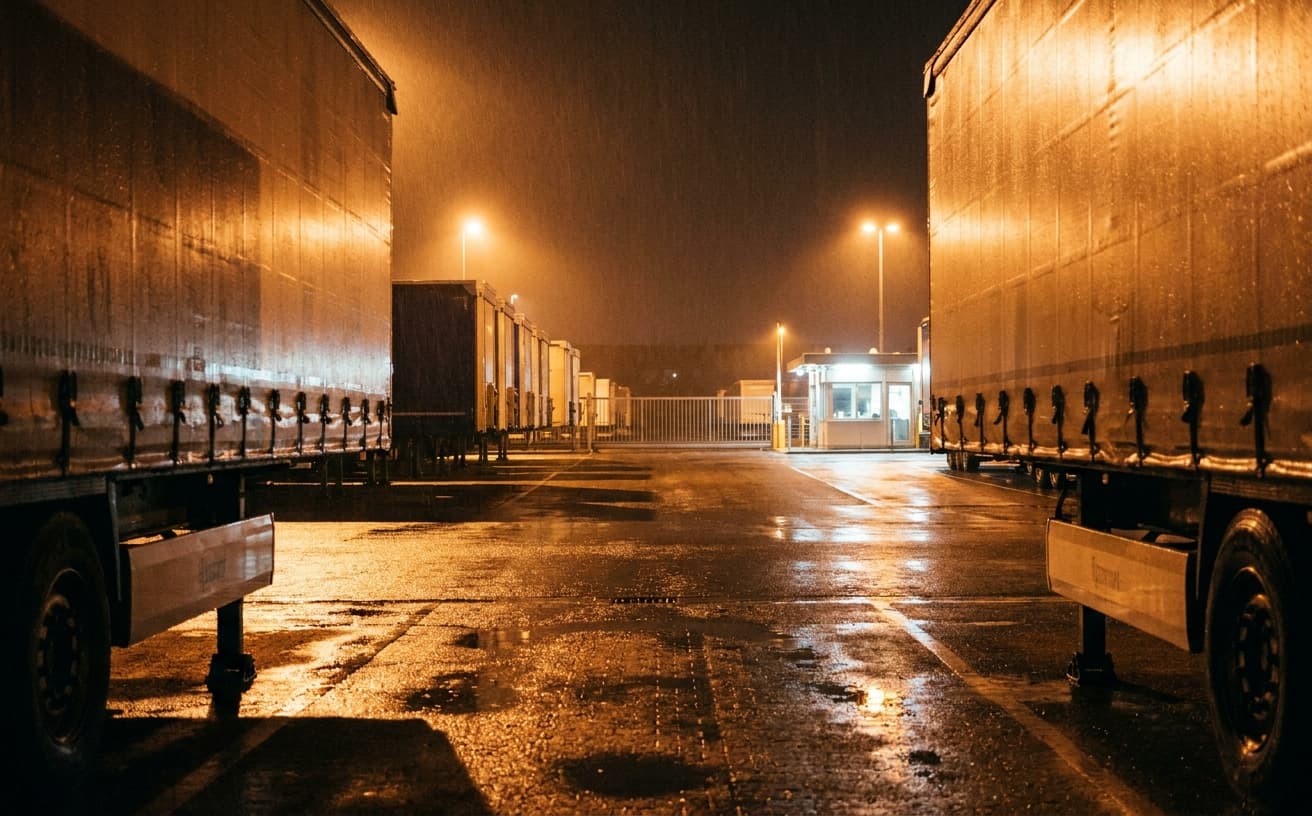
A truck yard is not a perimeter, it is a schedule with fences around it. Everything that fails at night fails because that distinction was not made on paper before it was made in steel.
Most overnight incidents at logistics yards are not the work of organized crime. They are opportunistic, fuel-driven, cargo-curious, and timed against the gap between the last shunt move and the first morning gate. The technology that buys an operator the next hour of sleep is the technology that respects that gap and reduces the number of decisions a remote watchstander has to make between two and four in the morning. Everything else is decoration.
What follows is a buyer-side plan. It is written from the manufacturer's bench, not from the integrator's pitch deck. It assumes the reader has lost diesel, lost a reefer load, or lost a morning to police paperwork at least once. If none of that has happened, the plan still applies, the urgency simply has not arrived yet.
What the yard actually is at night
A truck yard at one in the morning is not the same site that the day-shift dispatcher walks at ten. The lighting map shifts because half the sodium fixtures along the back fence were never replaced after the last storm. The acoustic floor changes because the highway noise drops and the reefer compressors become the dominant sound, which means microphones tuned for daytime baselines hear nothing useful. The thermal background drops, which helps thermal cameras and hurts cheap CMOS sensors. The human map collapses to a single yard jockey, sometimes none, and a guard who is either in a booth at the gate or driving a pickup along a route that has not changed in three years.
The first honest exercise is to map the yard as it exists between 22:00 and 05:00, not as it exists on the site plan. Where does light actually fall on the ground. Where do trailers park when the dispatcher does not assign a slot. Which gate is locked but unmonitored because the lock has been broken twice and nobody filed the work order. Which corner is invisible from the guard booth because a stack of empty containers grew there over six months. These are the questions a buyer answers before any camera is quoted, because every camera quote that arrives without these answers is selling hardware against assumptions.
Light pollution is the second exercise. Most yards are overlit at the dock face and underlit at the back fence, which trains the eye and the camera to find nothing at the fence because the dynamic range of the scene is wrong. CISA guidance on physical security for transportation assets has been consistent on this point for years. Uniform low-level light beats bright pools surrounded by black. The fix is rarely more fixtures, it is fewer fixtures aimed differently, and shielded so the camera at the back fence is not staring into a glare source two hundred meters away. Operators who skip this step buy thermal cameras to compensate for a lighting problem that costs less to solve than the cameras do.
The third exercise is route patterns. Whoever is moving through the yard at night, whether a guard, a jockey, or an intruder, follows lines of least resistance. Those lines are predictable. A buyer who has not walked them at the actual hour they matter is buying surveillance against a yard that does not exist.
Why the standard package fails between 02:00 and 04:00
The standard logistics-yard package, perimeter cameras, motion analytics, a guard tour, and a monitored alarm, fails in a narrow window for reasons that are structural rather than technical. Between roughly two and four in the morning, the operator at the remote monitoring center has been on shift long enough that attention has degraded, the guard on site, if there is one, is at the lowest point of his circadian curve, and the offender, if there is one, has had four hours to observe the pattern. The window is not random. NICB and ASIS International incident data on cargo theft point to this window consistently across years and across geographies.
Motion analytics fail in this window for a specific reason. The false-positive rate that was tolerable at 22:00, when an operator could glance and dismiss, becomes intolerable at 03:00, when the same operator is managing twelve sites and has learned, through six weeks of conditioning, that the alerts from this particular yard are almost always wind, a fox, or a tarp. The system is technically functioning. The human response chain is not. This is the failure mode that buyers do not see in a demo, because demos run for thirty minutes and human attention holds for thirty minutes.
The guard tour fails for the same reason. A guard who drives the same route at the same intervals teaches the yard to the observer, not the other way around. IEC 62443 thinking on industrial control systems, applied analogously to physical patrol, would call this a predictability vulnerability. The fix is not more guards, it is randomized routes, which most contracted services do not actually deliver because their dispatch tools do not support it and their personnel resist it.
The monitored alarm fails because the contractual response time, typically fifteen to twenty minutes for a Priority Two event, exceeds the offender's working window. By the time the responding patrol arrives, the diesel is gone, the trailer is open, or the catalytic converter is in a van. The alarm has done its job in the contract. It has not done its job in the yard. Operator-to-operator, this is the gap the conversation has to start with, because no technology investment closes a gap the operator does not first concede exists.
The buyer-side technology stack, in honest order
A useful stack for an overnight truck yard is built bottom-up, not top-down. The bottom is light and line of sight. The top is analytics. Buyers who start at the top spend money that the bottom would have made unnecessary.
The bottom layer is lighting that is uniform, shielded, and low-color-temperature enough not to bloom on camera. NIST guidance on lighting for security purposes is broadly aligned with what good cinematographers have known for a century. Even illumination reveals more than bright illumination, because the eye and the sensor can both resolve detail in mid-tones that they lose in highlights and shadows. Fixing this layer typically costs less than ten percent of the security budget and reduces the analytics workload by a margin that is hard to overstate.
The second layer is the physical line. Fence, gate, bollards, the trailer-parking pattern itself. A yard that parks high-value loads against the back fence is solving a dispatcher's problem and creating a security problem. A yard that parks high-value loads in the center, surrounded by empty trailers as a buffer, is doing the opposite. This is not technology, it is layout, and it is the cheapest intervention available. ISO 27001 thinking about asset classification applies here in physical form. Not every trailer needs the same protection. The ones that do should be where the protection actually reaches.
The third layer is fixed sensing. Cameras with the resolution and dynamic range appropriate to the lighting that now exists, thermal where the lighting cannot be fixed, and acoustic sensors tuned to the actual night-time baseline, not the daytime one. Placement matters more than count. A buyer who installs forty cameras to cover what twelve cameras placed correctly would cover is buying maintenance debt.
The fourth layer is mobile sensing. This is where the manufacturer's bench in the book BOSWAU + KNAUER. From Building to Security Technology argues for a specific separation of duties. Mobile units, whether ground robots or mobile video towers, do what fixed cameras cannot, which is to change the observation geometry and remove the predictability that a fixed installation hands to an offender. A mobile tower repositioned every shift, or a robot whose patrol route is genuinely randomized within defined zones, raises the offender's planning cost by an order of magnitude. The cost to the operator is configuration, not capital.
The fifth layer is analytics, and only the fifth. Analytics applied to a poorly lit, badly placed, predictable installation amplify the noise. Analytics applied to a clean stack amplify the signal. NIST CSF 2.0 frames detection as a function that depends on the integrity of the layers beneath it. That framing translates directly to the yard.
How the perimeter divides into response zones
A perimeter is not a line, it is a set of zones with different response logics. A yard that treats the perimeter as a single line forces every alert into the same response category, which is the structural reason for alert fatigue.
The first zone is the approach. This is everything outside the fence that the cameras and sensors can see. A vehicle slowing on the access road at 02:30 is information. A person on foot in a place where no person on foot has business is information. Neither is, by itself, a response trigger. The approach zone produces awareness. It feeds the operator's situational picture. It does not, except in defined cases, dispatch.
The second zone is the line itself. The fence, the gate, the wall. An alert here is a decision point. The operator has to determine whether the line has been tested, crossed, or merely brushed. This is where multi-sensor confirmation earns its cost. A fence sensor alone is a noise source. A fence sensor confirmed by a camera and a thermal channel is a decision.
The third zone is the interior buffer. The space between the line and the assets. This is where mobile assets, robots or mobile towers, do their highest-value work, because an offender who has crossed the line is now committed and the time-to-asset window is short. The interior buffer is where the response logic changes from observe to interdict. Dispatch happens here.
The fourth zone is the asset itself. The high-value trailer, the fuel island, the reefer with the pharmaceutical load. An alert at this zone is a maximum-priority event. There is no further confirmation step. The response is immediate, simultaneous, and coordinated with law enforcement notification as a default rather than as a judgment call.
Dividing the perimeter this way does two things. It reduces the cognitive load on the overnight operator, because each alert arrives pre-classified by zone and therefore pre-categorized in terms of response. And it gives the buyer a way to measure system performance, because the metric is not alerts per night but alerts per zone per night, which is the only metric that tracks operational reality.
How responses escalate overnight
Escalation is a sequence of conditional commitments, not a ladder. Each step commits more resources than the last, and each step has to be justified by what the previous step produced. A response framework that escalates automatically without conditional justification burns out the response chain in six weeks.
The first commitment is operator attention. An event in the approach zone or a low-confidence event at the line commits the operator to active observation for a defined window, typically two to five minutes. The system suppresses other alerts of equal or lower priority during that window so the operator is not split. If the window closes without escalation, the event is logged and the system returns to baseline.
The second commitment is sensor convergence. A confirmed line event or any interior-buffer event commits additional sensors to the location. Pan-tilt-zoom cameras orient. Mobile units, if present, reposition. Acoustic and thermal channels are weighted into the operator's display. This step takes thirty to ninety seconds and produces either a confirmed asset-zone trajectory or a return to baseline.
The third commitment is on-site response. This commits a guard, a mobile patrol, or in some configurations a remote audio challenge through the yard's PA system. The German BSI and the broader European framework around critical-infrastructure response treat the audio challenge as a distinct intervention, because it changes the offender's risk calculation without committing personnel. For a yard with no on-site guard between 22:00 and 05:00, the audio challenge is often the highest-value third step available.
The fourth commitment is law enforcement. This is reserved for confirmed asset-zone events or confirmed multi-person incursions. The threshold has to be high, because a yard that calls the police three times a month on false confirmations loses its police response within a quarter. The threshold has to be reachable, because a yard that never calls the police is a yard whose escalation logic is broken.
The fifth commitment, and the one most buyers do not write down, is the post-event commitment. Every escalation, whether it ended in an interdiction or a return to baseline, produces a data point. Those data points, aggregated weekly, are how the buyer adjusts the system. The yards that do this well are the yards where the overnight incident rate declines over two years rather than stays flat. GDV claims data in the German logistics sector show this pattern clearly. Yards that aggregate and adjust outperform yards that respond and forget.
How the handoff to morning staff is structured
The morning handoff is where most overnight security investments lose half their value. A yard manager who arrives at 06:00 and sees a green dashboard learns nothing. A yard manager who arrives at 06:00 and reads a three-line summary of the night, written by the overnight operator with specific reference to zones, times, and unresolved questions, has actionable information that changes the day.
The handoff has three components. The first is the incident log, which is mechanical. Every event, every escalation step, every resolution, time-stamped and zone-tagged. This is the record. It exists for insurance, for compliance with whatever frameworks the operator is held to, including NIST 800-53 controls for organizations that fall under federal contracting requirements, and for the operator's own week-over-week analysis.
The second is the operator narrative. This is the overnight watchstander's written account of anything that did not fit the log. The vehicle that drove past three times between 01:00 and 02:00 without stopping. The unusual acoustic signature near the fuel island that resolved to nothing but was inconsistent with the baseline. The fact that the back-fence camera lost focus for eleven minutes and was restored remotely. None of these are incidents. All of them are information that the morning shift needs to interpret what they see when they walk the yard. The narrative is short, declarative, and never optional.
The third is the unresolved-questions list. Every shift produces questions that the shift could not answer. Was the figure near the south gate at 03:14 a jogger or an observer. Why did the reefer at slot 17 cycle three times in twenty minutes when its setpoint was stable. Did anyone hear what sounded like a vehicle door at 04:40. These questions go to the morning manager not to be answered by him directly but to be tracked. A yard that tracks unresolved questions for ninety days develops a pattern recognition that no analytics package replicates, because the questions encode the local texture of the site.
The handoff is the moment the overnight system either pays for itself or does not. A buyer who has not specified the handoff in the same contract that specifies the cameras has bought a surveillance system and a guard service that do not, in any operational sense, talk to each other.
What holds
What holds is the discipline of treating overnight yard security as a system whose weakest link is the human chain, not the sensor chain. The technology that buys an operator the next hour of sleep is the technology that reduces decisions, classifies alerts by zone before they reach the operator, escalates conditionally rather than automatically, and produces a morning handoff that converts the night's data into the day's action.
A buyer who reads the above and recognizes the gap between the plan and the current installation has three useful next steps. The first is a sixty-minute confidential conversation in which the operator describes the yard as it actually is between 22:00 and 05:00, and the manufacturer's bench describes what would change. The second is a three-to-five-day audit at one yard, which produces a written assessment, a wirtschaftlichkeit calculation in three scenarios, and a prioritized list of interventions that the operator can execute with us, with someone else, or alone. The third is a ninety-day pilot at one site with a defined success metric agreed before installation. None of these commit the operator beyond the format they choose. All of them produce more clarity than another vendor demo.
Yards are not secured by procurement. They are secured by operators who decided, at a specific hour on a specific morning after a specific loss, that the next year would look different from the last one. The plan above is for that operator.
Frequently asked questions
What technology stack is right for a truck yard?
The right stack is built in five layers from the bottom up. Uniform shielded lighting first, because every layer above it depends on the scene the camera actually sees. Physical layout and asset placement second, because the cheapest intervention is moving the high-value trailer to where the protection reaches. Fixed sensing third, with resolution and dynamic range matched to the lighting, and thermal channels where lighting cannot be fixed. Mobile sensing fourth, robots or repositionable towers, to remove the predictability a fixed installation hands to an offender. Analytics fifth, applied to a clean stack rather than a noisy one.
How is the perimeter divided into response zones?
Into four zones with different response logics. The approach, outside the fence, produces awareness rather than dispatch. The line itself, the fence and gates, is a decision point requiring multi-sensor confirmation before escalation. The interior buffer, between the line and the assets, is where mobile units do their highest-value work and where the response logic changes from observe to interdict. The asset zone, the high-value trailer or fuel island, is a maximum-priority event with no further confirmation step. Each zone has a defined alert category, a defined response chain, and a defined metric.
How are responses escalated overnight?
Through five conditional commitments, each justified by what the previous step produced. Operator attention first, for a two-to-five-minute window with other alerts suppressed. Sensor convergence second, orienting cameras, mobile units, and thermal and acoustic channels to the location. On-site response third, which can be a guard, a mobile patrol, or a remote audio challenge through the yard PA. Law enforcement fourth, reserved for confirmed asset-zone events to protect the credibility of the response chain. Post-event aggregation fifth, where weekly review of escalation data adjusts the system over time. Automatic escalation without conditional justification burns out the response chain.
How is the handoff to morning staff structured?
In three components delivered at 06:00 or whenever the morning shift starts. The incident log is mechanical, every event time-stamped and zone-tagged, sufficient for insurance and compliance. The operator narrative is a short written account of anything that did not fit the log, the patterns and anomalies that did not become incidents but inform the day shift's interpretation of the yard. The unresolved-questions list tracks what the overnight shift could not answer, aggregated over ninety days to build pattern recognition that no analytics package replicates. A handoff not specified in the same contract as the cameras is a handoff that will not happen.
Related topics
- Cargo Theft Statistics 2026: The Carrier Breakdown
- Security Robots Across Dubai Free Zones: JAFZA & More
- Mobile Surveillance Towers at Jebel Ali Port
Take the next step: See prices & ROI · Explore the products · Send a no-obligation request. BOSWAU + KNAUER – direct from the factory in Filderstadt, reply within 5 working days.
About the author
Dr. Raphael Nagel (LL.M.) is founding partner of Tactical Management. He acquires and restructures industrial businesses in demanding market environments and writes on capital, geopolitics, and technological transformation. raphaelnagel.com
More reading
Since 1892.
The firm is reached at boswau-knauer.de or +49 177 2266267.