
Blog
UK Data Centre Corridor: Slough, Docklands & West London
Slough cluster, Docklands campus, West London hyperscaler builds. The UK data centre corridor and its security architecture.
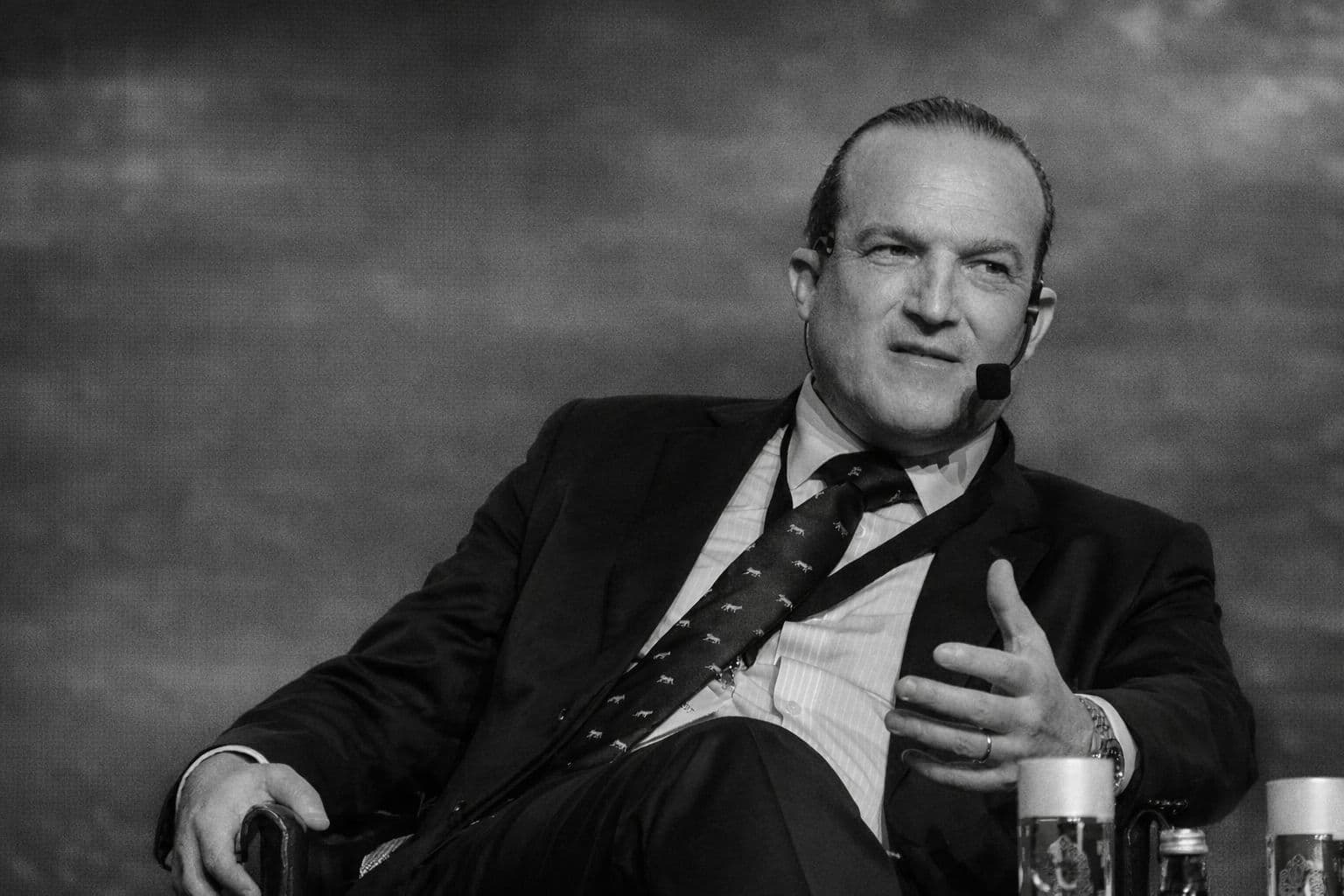
Dr. Raphael Nagel
September 22, 2025

The UK data centre corridor is not a market. It is a piece of national infrastructure that happens to be operated as a market.
That distinction matters because it changes how security is procured, how it is documented, and who carries the consequences when something fails. A market accepts the lowest compliant bid. A piece of national infrastructure does not. The corridor that runs from Slough through West London out to Docklands, with satellite clusters in Welwyn Garden City, Hemel Hempstead and Park Royal, now carries a load that was not anticipated when the first halls were poured in the late nineties. It carries the back office of British finance, large parts of the European cloud footprint of three American hyperscalers, sovereign workloads for Whitehall, and, increasingly, AI training clusters whose power draw alone reshapes the local grid.
Anything sitting on top of that physical layer, every digital service the country uses between Reading and Stratford, depends on a small number of fenced sites along the M4 and the A4. The security architecture of those sites is no longer a private commercial matter. It has become a question of national resilience, and operators inside the corridor have begun to behave as if that is the case, even where the regulator has not yet caught up.
The shape of the corridor
Slough Trading Estate carries the densest concentration of data centres in Europe by megawatts within a single postal area. Equinix operates a campus that has grown across multiple buildings since LD4 came online. Digital Realty, Virtus, Ark, Global Switch in Docklands, Telehouse along East India Dock Road, all of these names anchor what the industry calls FLAP-D, with London the L. The acronym hides the geographic reality, which is that London is in fact two clusters with very different security profiles, plus a feeder belt of smaller sites built where the power was available and the planning consent achievable.
Slough exists because the Trading Estate had legacy industrial power infrastructure and large flat plots on relatively cheap land within fibre distance of the City. Docklands exists because the financial services industry needed proximity to its own trading systems and was willing to pay for floor space inside a former dock. West London, around Park Royal and along the M4 corridor west of Heathrow, has filled in between the two, often on retrofitted industrial estates. Each of these geographies brings a different threat picture. Slough faces the issues of any concentrated industrial estate, perimeter density, shared access roads, lorry parks within sight of the fence line. Docklands faces the issues of any urban campus, pedestrian footfall, mixed use neighbours, limited standoff distance from public highway. West London sits between the two, often with heavier road traffic and longer service routes.
An operator running across all three has to defend three different building typologies under one corporate policy. That is harder than it looks on paper. Standard operating procedures written for a Slough hall do not transfer cleanly to a Docklands tower. The temptation to write one master document and append local annexes produces policies that nobody on the ground reads. The corridor has, quietly, moved away from that approach in the last three years, toward site-specific playbooks anchored in a common technology stack.
Who builds, who operates, who carries the risk
The corridor is built by a smaller group of companies than the industry's external presentation suggests. A handful of main contractors execute the hyperscaler shells. Mace, Sisk, Mercury Engineering, ISG before its collapse, and a tier of specialists for the mechanical, electrical and security packages. The hyperscaler client sets the design standard, the colocation operator sets the customer-facing standard, and the contractor is left to reconcile both with the realities of UK planning law, the Building Safety Act, and the available trades on a given Tuesday.
Security on these builds is rarely treated as a single package. It is split, often unhelpfully, between physical security construction, ELV systems integration, and operational security services. Three different procurement routes, three different points of accountability, frequently three different liability positions. When a perimeter breach happens during construction, which is the period when the corridor is most exposed, the question of who carries the loss is answered by reading three contracts in parallel. By that point the loss has already been carried by the programme.
The operator's perspective on this is straightforward. The shell hand-over date is the point at which security responsibility should be unambiguous, and the period from first fence to first customer move-in is the window in which the operator is most exposed and least covered. Construction sites carrying twelve to twenty million pounds in switchgear, transformer cores, lithium battery modules and copper cabling are not casual targets. The National Insurance Crime Bureau publishes US data showing how organised metal theft scales in active construction zones, and the UK pattern, tracked by the Association of British Insurers and the GDV's European counterparts in continental loss data, runs in parallel. The corridor has lost individual transformer deliveries in transit, copper bus bars from open compounds, and on one occasion a complete air handling unit lifted from a roof during a night shift. None of these events made the trade press. All of them appeared in someone's post-completion reconciliation.
What standards actually apply
The British standards landscape for data centre security is layered, and the layers do not always agree with each other. ISO 27001 covers the information security management system, which sits above the physical layer but increasingly references it. ISO 27001 Annex A 7 enumerates the physical controls, perimeter, entry, monitoring, that an operator has to implement and audit. EN 50600, the European data centre standard, classifies physical protection in four levels, with most hyperscaler builds targeting protection class three or four. The NIST Cybersecurity Framework 2.0, although American in origin, is now the de facto reference in UK enterprise security committees, and its Govern function is the bit that quietly pulls physical security onto the board agenda. IEC 62443 covers the industrial control systems inside the building, the BMS, the power monitoring, the cooling automation, and treats them as attackable infrastructure, which they are.
The UK's own contribution is the National Protective Security Authority, the successor to CPNI, whose guidance on hostile vehicle mitigation, perimeter intrusion detection, and insider threat is the document that British operators actually read when nobody is watching. The Centre for the Protection of National Infrastructure designation, where it applies, brings with it a set of expectations that do not appear in the commercial standards at all, around vetting, around supply chain, around the operational security of construction itself. ASIS International's General Security Risk Assessment guideline is the methodological backbone underneath most of this, and the BSI's PAS suite, particularly around resilience, fills in where the European standards are silent.
The honest position is that no single document tells an operator what to do. The standards overlap, the regulators triangulate, and the auditor reads whichever framework the client paid for. What matters in practice is whether the controls implemented at a given site survive a deliberate attempt to break them. That is the only test that counts, and it is not a paper test. The corridor's better operators run red team exercises against their own perimeter on a rolling basis, document the findings, and feed them back into the design review for the next phase. The corridor's weaker operators rely on the auditor's tick.
Fire, security and the coordination problem
Fire detection, gas suppression, security access control and intrusion detection are four systems that have to coexist inside the same hall without working against each other. The integration problem is older than the industry will admit. Smoke detection in a hot aisle with airflow above six metres per second behaves differently from smoke detection in a corridor. VESDA aspirating systems pull air continuously and detect at concentrations below human perception, which is the right approach for early warning, but they generate signals that have to be reconciled with the access control logs to distinguish a real incident from a contractor opening a panel.
The coordination point is the security operations centre, which on the better corridor sites is now a separate room with its own access controls and its own redundancy. The SOC takes feeds from CCTV, from access control, from VESDA, from the BMS, from perimeter intrusion detection, and from the operational technology side of the power and cooling plant. The operator's job is to triage these feeds without missing the one that matters. Modern installations use video analytics to pre-filter the CCTV stream, IEC 62443-compliant segmentation to keep the OT side from being reachable from the corporate IT network, and a runbook that defines what each combination of alarms means.
The coordination failure mode is well documented. A small fire alarm event triggers gas suppression, gas suppression triggers airflow change, airflow change triggers a thermal alert in the cooling system, the cooling system trips the affected hall, and somewhere in the middle of this cascade the access control system has unlocked the doors because of the fire mode. An attacker who understands this sequence can walk in during the window. The corridor has seen no public incident of this kind, but the scenario is rehearsed in tabletop exercises across operators, which is why the access control systems on newer halls now require dual factor authentication for re-entry even during fire mode, with a documented override path that logs to an external system.
The argument developed in the book BOSWAU + KNAUER. From Building to Security Technology applies directly here. Security systems that document everything but decide nothing are archives. Systems that decide quickly but document nothing are liabilities. The corridor's mature operators have moved to an architecture where decisions and documentation share a single data structure, which is what makes incident review and insurance recovery possible after the fact.
Construction phase exposure
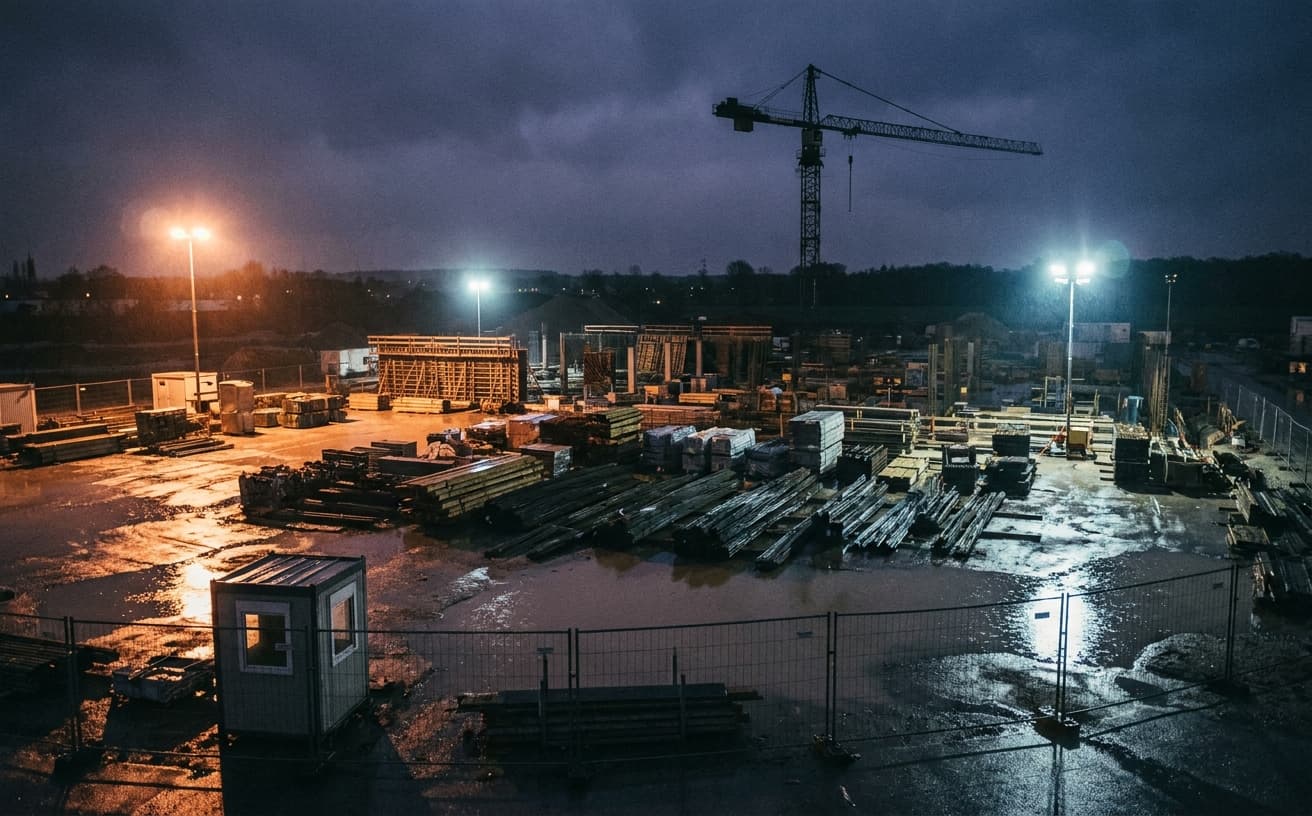
The period between groundbreaking and first customer is the window in which the corridor loses the most value, and it is the window in which security is most often improvised. Site fencing, temporary lighting, a manned guard hut at the gate, perhaps a mobile CCTV tower if the contractor has had a previous incident. This is the standard package, and it is inadequate to the materials values now sitting on UK data centre construction sites.
A switchgear delivery for a single hall can exceed two million pounds. A transformer can exceed three. The copper inside the busbar runs of a finished hall, at scrap value alone, justifies the attention of organised theft groups who track delivery schedules through subcontractor chatter and lorry park surveillance. The construction security model that worked for a logistics warehouse does not work for a substation-sized power infrastructure assembled outdoors over twelve months.
The operators who have understood this have moved the security architecture forward into the construction phase. Mobile video towers with onboard analytics replace the static guard hut at the perimeter. Autonomous patrol units cover the lay-down yards where transformers wait for installation. Thermal cameras watch the cable runs. Drone detection is now standard, because drones are now standard on the reconnaissance side. The cost of this package, run across a twelve to eighteen month build, is meaningfully less than a single transformer loss with consequential delay. The arithmetic is uncontroversial. The adoption has nevertheless been slower than the arithmetic would predict, because the security spend during construction sits in a different cost code from the operational security spend, and the contractor who carries the risk during construction is not the operator who benefits from the lower loss ratio afterwards.
This is a procurement problem before it is a technology problem. The corridor's best operators have started to write security continuity into the main contract, with the technology stack carried through from construction into operations rather than rebuilt at hand-over. That single change, treating the security architecture as a continuous deliverable across the lifecycle, removes a category of exposure that the industry has tolerated for too long.
The next ten years
Power is the constraint that will reshape the corridor more than anything else. The grid connection queue around Slough is the binding limit on new capacity, the National Grid's published transmission constraints make the West London problem explicit, and the Greater London Authority has signalled that further large draws will be examined with a different lens than was applied in 2015. New build is therefore shifting outward, to Welwyn, to the M25 north arc, to sites with viable connections that were not interesting to the industry five years ago. The corridor is dispersing.
Dispersion changes the security picture. A concentrated cluster is easier to defend because the resources, the contractors, the response times, the regulatory relationships, all scale within a small geography. A dispersed estate spread across home counties forces operators to build a security architecture that works at distance, with fewer people on each site and more reliance on remote monitoring and autonomous response. This is the direction the technology has been going regardless, but the corridor's expansion will accelerate it.
The other shift is the AI training load, which brings power densities and thermal profiles that the industry has not designed for. Liquid cooling at the cabinet, immersion cooling in dedicated halls, higher voltage distribution inside the building. Each of these introduces new failure modes that the security architecture has to accommodate. A leak in a liquid cooling loop is a different incident from a refrigerant leak in a CRAC unit, and the SOC runbook has to be rewritten.
What holds
The UK data centre corridor is a piece of national infrastructure operated by commercial entities under a patchwork of standards, with security architectures that have improved markedly in the last five years but still vary widely between sites. The mature operators have understood that security is a continuous deliverable across the lifecycle, that documentation and decision have to share a structure, and that the construction phase carries an exposure profile distinct from operations. The less mature operators are still procuring security as three separate packages and reading the contracts after the loss.
The corridor's expansion outward, driven by power constraints in the historic clusters, will force a further convergence on architectures that work at distance and with fewer people on site. The technology to do this exists. The operational discipline to deploy it is the binding constraint.
Operators in the corridor who want to test the position of their own estate against the patterns described here can start with a Path I conversation, sixty minutes, confidential, no follow-on obligation. For estates with multiple sites and a measurable loss history, a Path II audit across three to five days produces a written report with a schedule of findings that can be acted on internally or externally. Either route gives an operator a more honest picture of their position than the next compliance cycle will.
Frequently asked questions
How big is the UK DC corridor?
The corridor comprises roughly two gigawatts of installed IT capacity across Slough, Docklands, West London and the satellite clusters, with further capacity in planning or construction. Slough alone carries the densest concentration in Europe within a single postal area. Industry trackers including CBRE and Knight Frank publish quarterly absorption figures, but the operational reality is more compact than the headline numbers suggest. A small number of operators control the majority of the capacity, and the corridor's growth is now bounded by grid connection availability rather than by demand.
Who builds there?
Hyperscaler shells are typically executed by a tier of main contractors with data centre experience, Mace, Sisk, Mercury Engineering and historically ISG, supported by specialist mechanical, electrical and security contractors. The colocation operators, Equinix, Digital Realty, Virtus, Ark, Global Switch, Telehouse and others, either commission directly or develop on speculative basis. Hyperscaler tenants set the design standard. The build market is concentrated, which means a small number of project teams carry the bulk of the corridor's construction security exposure at any given time.
What standards apply?
ISO 27001 with its Annex A physical controls, EN 50600 for the data centre infrastructure, IEC 62443 for the operational technology systems, NIST CSF 2.0 as the de facto enterprise framework, NIST 800-53 where US clients require it, and NPSA guidance for sites with critical national infrastructure designation. ASIS International's risk assessment methodology and BSI's PAS resilience standards fill methodological gaps. No single document is sufficient. Mature operators triangulate across the layers and run independent red team exercises against their own controls.
How is fire and security coordinated?
Through a security operations centre that takes integrated feeds from fire detection, gas suppression, access control, CCTV with video analytics, perimeter intrusion detection and the building management system, with documented runbooks for combined alarm states. The known failure mode is the cascade where a fire event unlocks access control during the response window. Modern installations require dual-factor re-entry even in fire mode, with the override path logged externally. Coordination is a procedural and architectural question, not only a technology question, and it has to be rehearsed.
Related topics
- Extreme Heat & Security Robots in the Gulf: 55C
- Security Robots in Qatar: MOI Standards & Legacy
- Security Robots at DEWA: Utility Perimeter
- UK Energy CNI: ESO, National Grid & Substation Attacks
- UAE Incident Reporting: The 72-Hour Reality for Operators
- Critical Infrastructure Netherlands: NCTV & Rotterdam
Take the next step: See prices & ROI · Explore the products · Send a no-obligation request. BOSWAU + KNAUER – direct from the factory in Filderstadt, reply within 5 working days.
About the author
Dr. Raphael Nagel (LL.M.) is founding partner of Tactical Management. He acquires and restructures industrial businesses in demanding market environments and writes on capital, geopolitics, and technological transformation. raphaelnagel.com
More reading
Since 1892.
The firm is reached at boswau-knauer.de or +49 177 2266267.