
Blog
UK Energy CNI: ESO, National Grid & Substation Attacks
ESO, National Grid, NERC equivalence and divergence. UK substation security in a post-Metcalf, post-Moore-County frame.
Dr. Raphael Nagel
June 27, 2025
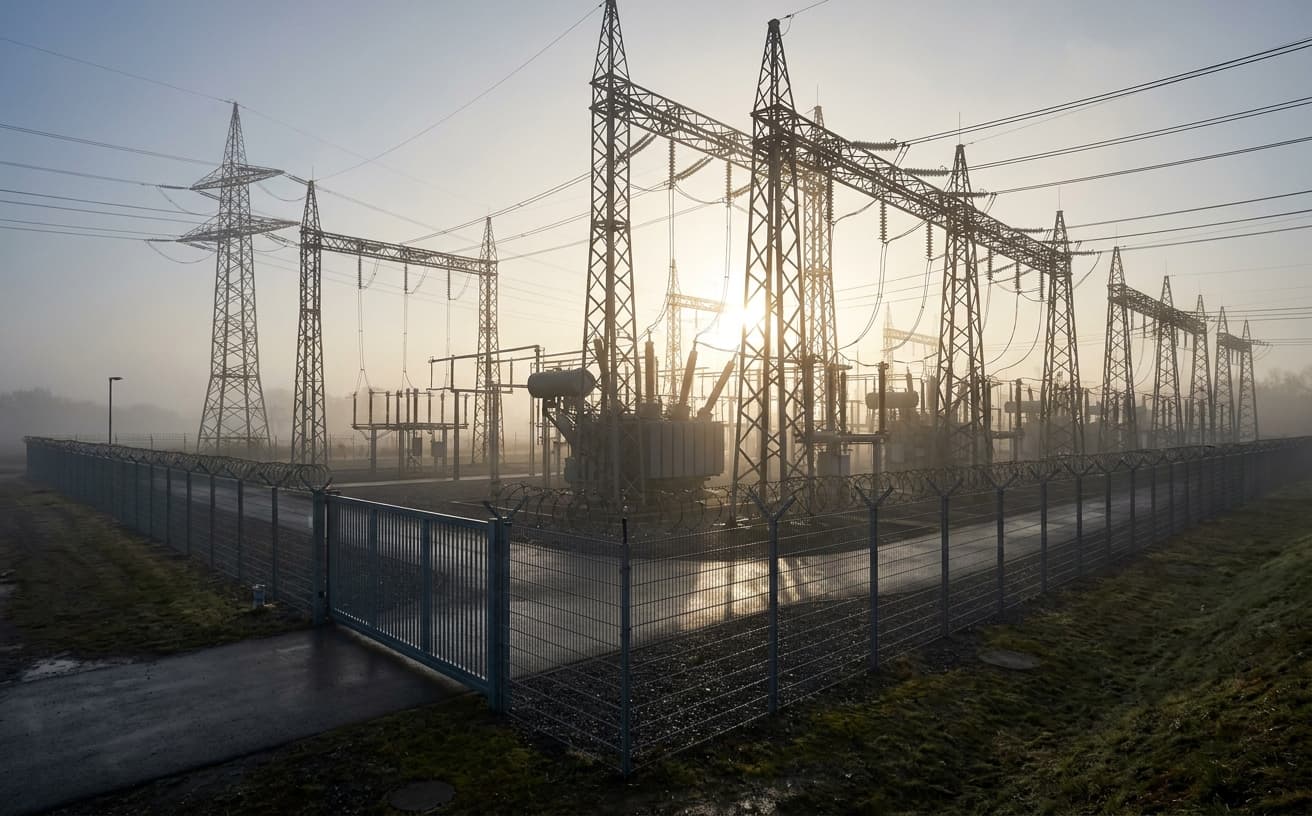
The British electricity grid is governed by a constellation of bodies whose names change faster than the threat picture they are meant to address, and the physical assets they protect, several thousand substations sitting on accessible land, have not been hardened in proportion to the risk that the post-Metcalf, post-Moore County period has made evident.
The transition from National Grid ESO to the publicly owned National Energy System Operator in 2024 was framed in policy circles as a governance reform. From a security operator's perspective it was something more uncomfortable. It was an admission that the operational coordination of the British grid had become too consequential to remain inside a privately owned holding structure, and that the question of who is accountable for resilience had become non-trivial. That admission did not, in itself, secure a single fence line. It changed the masthead under which the question is now asked.
This article approaches the question from the position of a manufacturer that builds for the conditions in which substations actually live. Field perimeters with limited line-of-sight. Remote rural locations with no permanent staffing. Anti-climb measures that meet a 1990s threat model. CCTV that records but does not detect. The argument here is not that British operators are negligent. It is that the regulatory architecture under which they operate has not, until recently, required them to engineer against the threat profile that two well-documented North American incidents have established as plausible.
What ESO actually is, and why the name matters
The Electricity System Operator, since October 2024 renamed and restructured as the National Energy System Operator, is the entity that balances supply and demand on the transmission network in real time. It does not own substations. It does not own pylons. It does not patrol fence lines. National Grid Electricity Transmission, a separate legal entity within the National Grid group, owns and maintains the transmission assets in England and Wales. Scottish Power Transmission and SSEN Transmission perform the equivalent role in Scotland. The distribution network operators, the DNOs, own the lower-voltage assets that connect to end users.
This separation matters for any conversation about substation security because the locus of responsibility for the physical asset, the locus of responsibility for system operation, and the locus of responsibility for regulatory compliance are not the same. The ESO sets some operational standards. Ofgem sets the price control framework that determines how much the asset owners can spend on resilience. The Centre for the Protection of National Infrastructure, now reorganised within the National Protective Security Authority under MI5, provides protective security guidance. The Department for Energy Security and Net Zero sets policy. The National Cyber Security Centre, part of GCHQ, handles the cyber dimension. Five entities, plus the asset owners themselves, plus the police forces that respond to incidents.
This dispersion is not unusual in liberalised energy markets. It is the structure that emerged from the privatisation of the Central Electricity Generating Board in 1990 and the subsequent unbundling that European law required. The cost of the structure is that no single body has comprehensive authority over the question this article addresses, which is whether a determined attacker with a rifle and basic reconnaissance could remove a high-voltage transformer from service for the months required to replace it. The benefit of the structure, in principle, is that it forces conversation between specialists who would otherwise operate in silos. The benefit is not always realised.
The renaming to NESO is more than cosmetic. The new entity is owned by the Department, not by a listed plc. Its accountability runs upward to ministers and, through them, to Parliament. The expectation, in the security community, is that this changes the calculus on resilience investment over the coming price control period. Whether it actually does is a question to be settled by evidence, not by announcement.
NERC equivalence and divergence
In North America, the North American Electric Reliability Corporation sets mandatory standards for the bulk electric system. The CIP series, Critical Infrastructure Protection, includes CIP-014, which addresses physical security of transmission stations and substations identified through a risk assessment as critical. CIP-014 was promulgated in direct response to the Metcalf substation attack in California in April 2013, in which gunmen disabled seventeen transformers with rifle fire. The standard is enforceable. Non-compliance carries financial penalties.
The United Kingdom has no direct equivalent. Substation physical security in Britain is governed by a combination of the Network and Information Systems Regulations 2018, which transposed the EU NIS Directive and which focuses primarily on cyber resilience, the Energy Act 2023, which expanded ministerial powers over the energy system, and the security elements embedded in operators' licence conditions under Ofgem. The Centre for the Protection of National Infrastructure, now the NPSA, publishes protective security advice that operators are encouraged to follow. The word encouraged is doing significant work in that sentence.
The comparison with NERC CIP-014 is instructive not because the British system is failing in some catastrophic sense, it is not, but because the architectural difference produces different incentives. A US transmission operator subject to CIP-014 must identify its critical substations through a defined methodology, must develop a physical security plan, must have that plan independently verified, and must implement it. Failure to do so is sanctionable. A UK transmission operator has obligations under licence conditions that are real but less prescriptive on the physical security dimension. The operator's spending on resilience is constrained by the price control settlement that Ofgem negotiates every five to eight years. The framework was designed to constrain costs to consumers. It was not designed with a Metcalf-style attack in the foreground.
The IEC 62443 series, the relevant international standard for industrial automation and control systems, addresses the cyber-physical boundary where most modern threats actually live. ISO 27001 provides the information security management framework that most operators use. NIST CSF 2.0, although a US document, is increasingly referenced by British operators as a common vocabulary for discussions with insurers and international counterparties. None of these standards, on their own, requires the kind of physical hardening that CIP-014 mandates. They permit it. They do not compel it.
The Metcalf and Moore County precedents
The Metcalf attack in 2013 took the industry by surprise. Coordinated rifle fire from outside the fence, telecommunications cables cut to delay response, transformers leaking oil, no arrests. The Federal Energy Regulatory Commission acted within months. The standard was in place within a year. The North American Electric Reliability Corporation operated with a clarity of mandate that its British counterparts do not possess.
The Moore County attack in North Carolina in December 2022 was different in character but similar in implication. Two substations were attacked by gunfire. Approximately forty-five thousand customers lost power. The outage lasted days. The motive was never definitively established. The point, from a security planning perspective, is not the motive. The point is that the attack required limited resources, produced significant disruption, and demonstrated that the post-Metcalf hardening regime had not eliminated the vulnerability class, only reduced it on the specific assets that fell within CIP-014's scope.
Both incidents have been studied in detail by British security professionals. The conclusions, where they have been written down, are not reassuring. The British substation estate is, on average, less hardened than the equivalent US estate post-Metcalf. The threat actors are different, the geography is different, the political context is different. The physics of a transformer hit by a high-velocity round are the same. The replacement lead time for a large grid transformer, between twelve and twenty-four months depending on specification and supplier, is the same. The financial consequence of a multi-week outage in a major load centre is the same.
The British response, where it has occurred, has been gradual. Selected sites have been hardened. The NPSA has issued guidance. Operators have invested in CCTV, in perimeter detection, in some cases in robotic patrols. The investment is real but uneven. It is concentrated on the assets that are most visible and most politically sensitive, which is not always the same set as the assets that are most consequential from a system-operation perspective. The book BOSWAU + KNAUER. From Building to Security Technology develops this point in the context of industrial sites: the assets that matter most to continuity are not always the ones that look most important from outside the fence.
What modern substation protection looks like
The classical substation security stack consists of a perimeter fence, anti-climb measures at the top of the fence, intruder detection on the fence line, CCTV with recording, and a response arrangement, typically a police call-out rather than a guarded response. This stack was designed against a threat model of opportunistic intrusion, copper theft, and vandalism. It is reasonably effective against that threat model. It is structurally inadequate against a Metcalf-style threat.
The threats that current planning must consider include standoff attacks with firearms, drone-based reconnaissance and payload delivery, coordinated cyber-physical attacks that disable detection systems before the physical action, and insider-enabled actions where credentials or knowledge are provided to external actors. Each of these requires a different element of the defensive stack to respond. Standoff attacks require detection at a range that traditional fence-line systems do not provide, and ideally require deflection or hardening of the targeted equipment itself. Drone threats require airspace awareness and, where legally permissible, counter-drone capability. Cyber-physical attacks require the cyber and physical security functions to operate as a single team, which in many operators they do not. Insider threats require personnel security disciplines that are well established in defence and intelligence environments but less developed in commercial energy.
The technological response that this manufacturer has developed addresses several of these layers. Autonomous patrol systems, mobile video towers with thermal and acoustic sensing, AI-supported video analysis that distinguishes a fox from a person from a vehicle, integrated platforms that connect physical detection to operator dashboards in real time. None of this is a substitute for the underlying hardening of the asset. It is a supplement that compresses detection-to-response time from the tens of minutes that traditional CCTV-plus-police-response produces, to the seconds that a coordinated attack actually allows. The substation that registers an intrusion ten minutes after it began has lost. The substation that registers an intrusion within seconds, classifies it, and triggers a graduated response has options.
The cost question that always follows is genuine but often misframed. A modern substation protection upgrade for a single critical site, including perimeter detection, video analytics, robotic patrols where appropriate, and integration with a 24-hour monitoring centre, is a six-figure investment over the asset lifetime. The cost of a single transformer replacement following a successful attack, including the equipment itself, the outage management, the regulatory response, and the reputational consequence, is a seven to eight figure number. The arithmetic is not difficult. The reason the arithmetic has not driven faster investment is the price control framework, not the engineering.
Audit, ownership, and the question of accountability
The British system places ultimate accountability for substation security on the asset owner. National Grid Electricity Transmission for the English and Welsh transmission network, the Scottish transmission operators for their territories, the DNOs for distribution assets. This accountability is real. It is also distributed across multiple boards, multiple security directors, and multiple operational regions. There is no single accountable executive for the resilience of the British substation estate considered as a system.
Audit, in the British framework, is performed at multiple levels. Internal audit functions within each operator. Ofgem-commissioned reviews of resilience as part of the price control process. NPSA reviews of designated critical assets. NCSC reviews of the cyber dimension. The Information Commissioner's Office where data protection issues are engaged. Insurance assessors where insurance arrangements require it. Independent technical audits commissioned by the operators themselves. This is not nothing. It is not the integrated, mandatory, sanctionable audit regime that CIP-014 produces in North America.
ASIS International, the global association for security management professionals, has published frameworks for physical security assessment that are widely used in British practice. The BSI publishes standards on physical security that operators reference. The GDV, the German insurance association, publishes loss data that informs European underwriting practice and that British insurers consult. These resources are available. The question is how they are applied. An audit that produces a report that sits in a drawer is a cost without a benefit. An audit that produces a list of prioritised investments tied to a measurable risk reduction is the foundation of resilience.
The three paths that this manufacturer offers to operators considering an upgrade reflect this audit-first logic. Path I is a sixty-minute confidential conversation in which the operator describes the asset class, the threat profile, and the constraints, and the manufacturer describes what it would do in the operator's place. No deliverable, no commitment. Path II is a three to five day audit of selected sites, producing a written report with prioritised recommendations that the operator can implement with this manufacturer, with another supplier, or internally. Path III is a ninety-day pilot at a defined site with defined success criteria, at the end of which the operator has data on which to base a scaling decision. The paths are sequential by design but each stands alone.
What holds
The British grid is reliable by historical standards and by international comparison. The substation estate has not, to date, been the target of a successful Metcalf-class attack. The absence of such an attack is not evidence that the defensive posture is adequate. It is evidence that the threat has not yet been actualised at scale in this jurisdiction. The Moore County precedent demonstrates that the threat does not require sophisticated capability. It requires intent.
The renaming of National Grid ESO to NESO, the gradual modernisation of NPSA guidance, the increasing convergence of UK practice with NIST CSF 2.0 and IEC 62443, the slow uptake of modern detection and response technology at critical sites, these are real developments. They are not, taken together, equivalent to the post-Metcalf regulatory response that the North American system produced. Whether that gap matters depends on assumptions about threat that no one in the open literature can verify.
Operators who want to test their own posture against the question that this article frames have three options. They can wait for a regulator to require action. They can act on their own initiative based on the data they already have. They can commission an independent assessment that converts the question into a list. The audit path described above is one route to the third option. The conversation path is the lower-commitment entry point for an operator who wants to think through the question before commissioning anything.
Frequently asked questions
What is ESO?
The Electricity System Operator was the body responsible for real-time balancing of the British transmission system. In October 2024 it was restructured into the National Energy System Operator, a publicly owned entity sitting under the Department for Energy Security and Net Zero. NESO coordinates the operation of the grid. It does not own substations or transmission assets. Those are owned by National Grid Electricity Transmission in England and Wales, by Scottish Power Transmission and SSEN Transmission in Scotland, and by the distribution network operators at lower voltages. The naming change reflects a shift to public accountability.
How does the UK regulate substations?
Substation regulation in the UK is distributed across several bodies. Ofgem sets the price control framework that determines resilience spending. The Network and Information Systems Regulations 2018 address cyber resilience. The National Protective Security Authority, formerly CPNI, issues physical security guidance. The NCSC handles cyber threats. Operators' licence conditions contain security obligations. There is no single mandatory standard equivalent to NERC CIP-014 in North America. The framework is principles-based rather than prescriptive on physical security, which produces flexibility and, in some assessments, inconsistency across the estate.
Has there been an attack?
There has been no publicly documented Metcalf-class attack on a British substation. There have been incidents of theft, vandalism, and intrusion across the estate, which are routinely reported in operator filings and in police data. The absence of a high-profile coordinated attack is not, in itself, evidence that the defensive posture is adequate against such an attack. The Metcalf attack in 2013 and the Moore County attack in 2022, both in the United States, are the reference incidents in security planning. British operators study them. The question is what follows from the study.
Who audits?
Audit of British substation security is performed at multiple levels. Internal audit within the asset-owning operators. Ofgem-commissioned reviews as part of the price control process. NPSA reviews of designated critical assets. NCSC reviews of cyber posture. Insurance-driven assessments where coverage requires them. Independent technical audits commissioned by operators themselves. ASIS International, BSI, and ISO 27001 frameworks are commonly applied. The structure differs from the North American model, where NERC-mandated audits are sanctionable. Operators seeking an independent assessment outside the regulatory cycle can commission one through the audit path described in this article.
Related topics
- NPSA Physical Security: The UK Guidance Everyone Misreads
- NIST 800-53 Physical Controls: What Every CISO Mistranslates
- CISA's Voluntary Framework Is a National-Security Failure
- CISA Physical Security for Chemical Sites: A Practical Read
- NPSA and UK Physical Security: The New National Standard
- Critical Infrastructure Netherlands: NCTV & Rotterdam
Take the next step: See prices & ROI · Explore the products · Send a no-obligation request. BOSWAU + KNAUER – direct from the factory in Filderstadt, reply within 5 working days.
About the author
Dr. Raphael Nagel (LL.M.) is founding partner of Tactical Management. He acquires and restructures industrial businesses in demanding market environments and writes on capital, geopolitics, and technological transformation. raphaelnagel.com
More reading
Since 1892.
The firm is reached at boswau-knauer.de or +49 177 2266267.