
Blog
UK Construction Mobile Surveillance: Why Operators Switch
WCCTV market position, the RedSnapper challenger and contract durations. What is really driving the UK construction mobile surveillance market in 2026.

Dr. Raphael Nagel
August 6, 2025
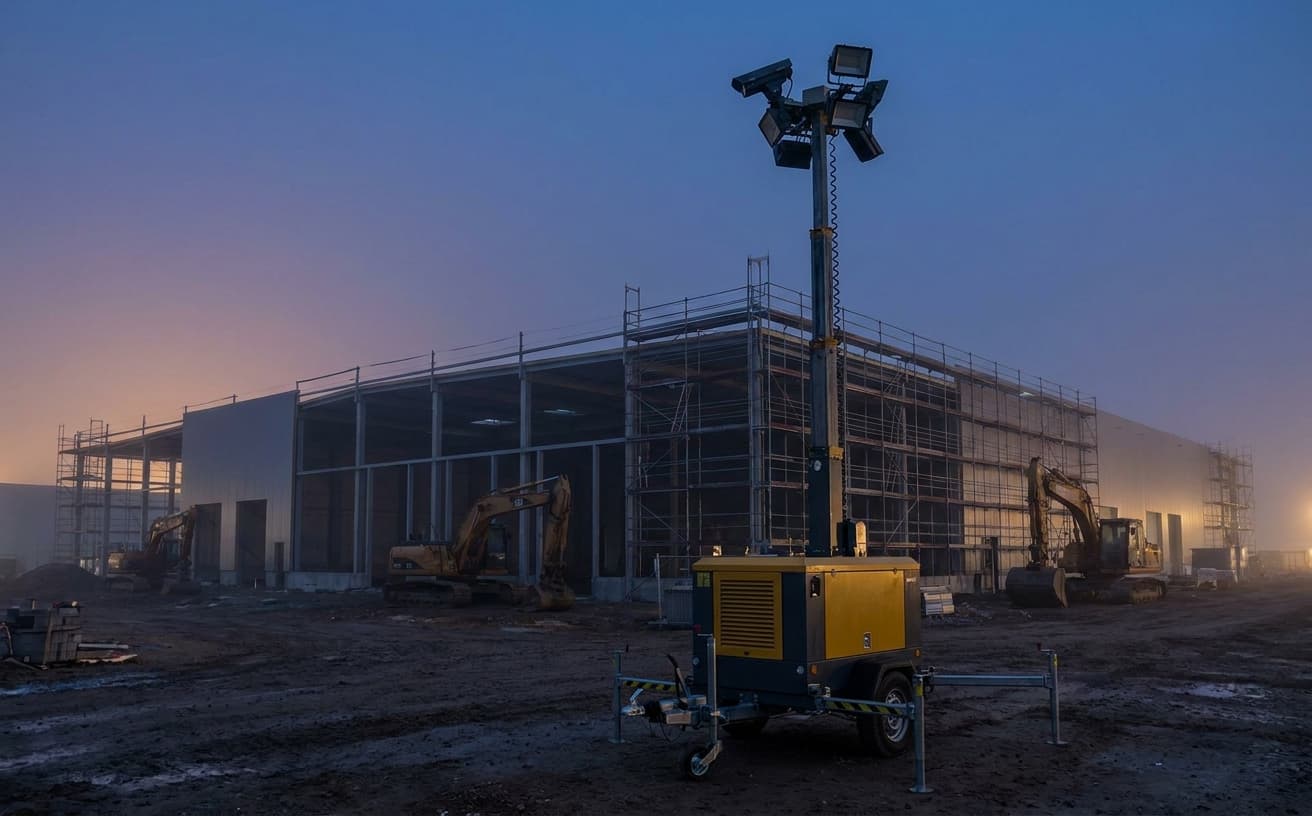
Market leadership in mobile construction surveillance is a function of contract duration, not technology.
The United Kingdom hosts the most developed mobile video tower market in Europe, with a per-site density and a service maturity that continental operators study before they buy. Within that market, one supplier sits at the top of every shortlist, and the reasons are not the ones the trade press repeats. WCCTV did not win the UK by inventing the redeployable tower. It won by treating each tower as a multi-year service contract with a defined uplift profile, and by building an operational backbone that competitors have so far failed to replicate at scale. The challenger, RedSnapper, is well known on roads and rail and increasingly visible on civil engineering sites, but the gap in installed base is wider than headline figures suggest.
What follows is a structural reading of that market, written from a manufacturer's perspective. It is not a buying guide. It is an account of why operators sign with one supplier, why they sometimes switch, and what the construction client should measure when the renewal letter arrives.
The shape of the UK mobile surveillance market
The UK mobile surveillance market for construction is concentrated in a way that surprises operators arriving from German or French markets. Three suppliers handle the majority of redeployable tower deployments on tier-one and tier-two construction sites. WCCTV, headquartered in Greater Manchester, holds the dominant position. RedSnapper Systems, with its rapid-deploy CCTV unit, occupies the second tier alongside a small number of regional integrators. Below them sit a long tail of local firms, often operating refurbished towers under white-label arrangements with national alarm receiving centres.
The concentration has historical roots. WCCTV moved early into transmission compression and remote video monitoring at a moment when 3G networks were not yet usable for live streaming on construction sites. The firm built a proprietary codec, paired it with a managed connectivity layer, and offered the package as a service rather than a product. By the time competitors offered comparable bandwidth efficiency, WCCTV had a base of long-running contracts, a service organisation across multiple depots, and a reputation with insurers that translated into easier underwriting for clients who specified its hardware.
That structural lead matters because mobile surveillance in construction is not a hardware decision. It is a workflow decision. The tower itself is one component. The alarm receiving centre, the response procedure, the storage retention, the police response level, the redeployment logistics, the SIM management, the offline buffering, the verification process under BS 8418, and the integration with site induction systems all weigh more in the operator's daily reality than the camera resolution. WCCTV's competitive moat sits in that workflow layer, not in the steel and optics on the mast.
The market is also shaped by insurance. UK insurers have grown increasingly specific about what they accept as mitigation on construction sites with copper, plant, and high-value modular assemblies exposed overnight. Several insurers maintain informal preferred lists, and WCCTV appears on most of them because its incident data is auditable and its response chain has been tested across thousands of activations. A challenger entering this market without that data trail starts the conversation a step behind.
Why WCCTV dominates: the contract logic
WCCTV's dominance is best understood through its contract architecture rather than its product catalogue. The standard arrangement on a UK construction site is a hire contract with a minimum term of twelve months, often extended to twenty-four or thirty-six months depending on the project programme. The contract bundles hardware, connectivity, monitoring, response coordination, and redeployment between phases. Pricing is structured as a monthly fee per tower, with reductions for multi-unit deployments and uplifts for higher monitoring intensity.
This structure has three effects that competitors find difficult to dislodge. First, it removes capital expenditure from the client's decision. A principal contractor running a two-year scheme does not want a tower on its balance sheet. The hire model fits the project accounting. Second, it creates switching friction. Once a site has been commissioned, with alarm receiving centre integration, site-specific detection zones, and induction material referencing the supplier's contact protocols, replacing the supplier mid-contract carries operational cost that often exceeds the saving. Third, it builds a recurring revenue base that funds the supplier's investment in firmware, analytics, and depot capacity. Each year of contract renewals compounds the supplier's ability to underwrite the next generation of hardware without margin pressure.
The challenger model is harder. RedSnapper and the regional integrators sell shorter contracts, sometimes on a project-by-project basis, sometimes monthly with thirty-day termination. The flexibility is attractive to smaller contractors, but it cuts the supplier's ability to amortise depot infrastructure across a stable base. It also reduces the supplier's negotiating position with insurers, because the data trail is shorter and the response performance is harder to demonstrate over multiple sites.
Construction operators who have audited their own surveillance spend often find that the headline rate is not the variable that drives total cost. The drivers are redeployment frequency, false alarm rate, response escalation cost, and the cost of any incident the system failed to prevent. A tower that costs fifteen per cent less per month but generates twice the false activations costs more in monitoring fees and operator fatigue than the cheaper headline suggests. WCCTV's installed base allows it to tune analytics against a broader dataset, and the resulting false alarm performance is consistently cited by tier-one contractors as the reason they have not changed supplier. That advantage is not unassailable, but it requires a challenger to invest in data infrastructure before it invests in fleet.
The RedSnapper challenge and where it works
RedSnapper Systems has built a credible position by entering the market where WCCTV is structurally weaker, which is the short-duration deployment with a defined civil engineering profile. Highways works, utility schemes, rail possessions, and event-driven security all favour units that can be deployed inside hours, monitored against a defined risk window, and decommissioned without the contractual overhead of a long hire. RedSnapper's RSS unit is well regarded in this segment and has gained ground with operators who run portfolios of short engagements rather than single multi-year construction programmes.
The firm has also benefited from a more flexible commercial posture. Where WCCTV typically requires a minimum term, RedSnapper has been willing to engage on shorter cycles and to integrate with the client's own alarm receiving centre rather than insisting on its in-house monitoring. For construction clients with mature internal security operations, that flexibility matters. It allows the client to retain control of the response chain, to standardise across suppliers, and to avoid the data silos that long-term single-supplier relationships tend to create.
The structural ceiling for RedSnapper is the same ceiling that limits any challenger in a service-dominated market. Without the recurring revenue base of long contracts, the depot footprint is harder to scale. Without the depot footprint, response times in remote regions become uncompetitive. Without competitive regional response, the insurer relationships do not deepen. The challenger can grow, and is growing, but the path to overtaking the incumbent requires either a step change in technology that resets the analytics conversation, or a structural shift in how construction clients procure surveillance. Neither is impossible. Neither is imminent.
What construction operators should note is that the challenger's growth has improved the incumbent's behaviour. WCCTV's contract terms have softened in the last twenty-four months, with shorter minimum terms available on negotiation, more transparent uplift pricing, and faster response to performance complaints. A market with one credible challenger is healthier for the buyer than a market with none.
When operators switch suppliers
Switching events in this market are rare but not random. Three patterns recur across the construction operators who have changed mobile surveillance supplier in the last three years.
The first pattern is performance failure on a high-profile incident. When a system fails to detect or fails to escalate during a theft that reaches six or seven figures, the client conducts an internal review, and the review often reaches the boardroom. If the supplier's incident report shows a configuration gap, a false alarm history that masked the genuine event, or a response chain that broke down between detection and police dispatch, the relationship rarely survives the next renewal. This is the most common driver of switches at tier-one level, and it explains why supplier performance reviews have become a standing item in many construction security committees.
The second pattern is consolidation pressure from group procurement. Construction groups operating across civils, building, and infrastructure increasingly want a single surveillance supplier across the portfolio, with consolidated reporting and a single commercial relationship. Where the incumbent supplier cannot deliver the geographic coverage or the data integration the group requires, procurement moves the contract. The supplier that wins these consolidation tenders is rarely the cheapest, but it is consistently the one that can demonstrate API-level integration with the client's incident management platform and produce evidence for ISO 27001 audit trails on data handling.
The third pattern is technological obsolescence on the client's side. As construction clients adopt connected site platforms, with access control, plant telematics, and environmental monitoring feeding a single operations dashboard, surveillance suppliers that cannot integrate at data level fall behind. This is where the NIST Cybersecurity Framework 2.0 vocabulary, with its identify, protect, detect, respond, and recover functions, has started to appear in tender documents. Clients want to know how the surveillance supplier fits into each function and what evidence is produced for each. Suppliers that answer in marketing terms lose. Suppliers that answer with architecture diagrams, IEC 62443 zone and conduit mappings, and documented incident playbooks win the next contract.
Switches driven by price alone are uncommon at the tier-one level. They occur more frequently in the tier-two and regional segments, where margin pressure on the contractor is higher and the surveillance line item is one of the more visible discretionary costs. In those cases the switch often reverses within two contract cycles once the operational consequences of the cheaper alternative become visible in incident data.
What performance measurement actually requires
The construction operator who wants to manage a mobile surveillance contract on evidence rather than impression needs four classes of data, and most contracts do not produce them by default. The first class is detection performance, expressed as the ratio of confirmed events to total activations across a defined period. A tower generating three hundred activations a month with two confirmed events is not the same asset as a tower generating forty activations with two confirmed events, even if both report the same incident outcome.
The second class is response performance, measured from detection to verified escalation. This is where the alarm receiving centre's procedures and staffing become visible. BS 8418 sets the framework for remote video monitoring in the UK, and reputable suppliers operate within it, but the framework defines the minimum, not the achievable. Tier-one operators increasingly demand response time distributions, not averages, because the average hides the long tail that matters.
The third class is availability, measured as the percentage of contracted hours during which the tower was fully operational, including connectivity, power, and analytics. Towers with solar and battery configurations need particular attention here, because the winter performance in northern latitudes can degrade in ways the summer commissioning does not reveal. Honest suppliers produce this data without prompting. Suppliers who treat availability as a commercial sensitivity should be asked why.
The fourth class is the incident outcome trail, from initial detection through police engagement, recovery, insurance notification, and any subsequent civil or criminal action. This is the dataset that informs the insurer relationship and the one that justifies the surveillance budget at board level. It is also the dataset most often missing when a construction client asks its supplier for an annual performance review. The book BOSWAU + KNAUER. From Building to Security Technology develops this point at length, arguing that the operator who cannot reconstruct the chain from sensor activation to recovered asset is not measuring security, only paying for it.
The CISA guidance on physical security, the ASIS International protection of assets standards, and the GDV recommendations on construction site security all converge on the same point. Surveillance is an evidentiary system, and its value is realised at the moment the evidence is needed. Operators who treat it as a deterrent alone, without measuring its forensic and procedural performance, will discover the gap at the worst possible moment.
What holds
The UK mobile construction surveillance market in 2026 is a market shaped by contract architecture more than by hardware specification. WCCTV's dominance is structural, built on long contracts, an established data trail with insurers, and a service infrastructure that competitors cannot replicate without sustained investment. RedSnapper's challenge is genuine but currently confined to segments where short-duration deployment and commercial flexibility outweigh the depth of the incumbent's response chain.
For construction operators, the practical lesson is that supplier selection should be conducted on evidence, not on demonstration. The four data classes above produce the evidence. The annual performance review produces the discipline. The switching event, when it comes, is the audit the relationship never had.
BOSWAU + KNAUER is not a UK supplier of mobile video towers and does not compete in that market. The firm's interest is in the operator who runs surveillance across geographies and asset classes and needs an independent reading of what its current supplier delivers against what the market makes possible. For that conversation, the firm offers a sixty-minute confidential exchange under Path I, structured to leave the operator with a sharper view of its own data, regardless of whether any further engagement follows.
Frequently asked questions
Who leads the UK market?
WCCTV, headquartered in Greater Manchester, holds the dominant position in mobile video tower deployment across UK construction sites. Its lead is structural, built on long-duration hire contracts, an established alarm receiving centre infrastructure, a documented incident history with insurers, and a depot footprint that supports rapid redeployment across the country. RedSnapper Systems is the most credible challenger, particularly in short-duration civil engineering and event-driven applications. Below the two named suppliers sits a fragmented tier of regional integrators operating under varying commercial models, often with white-label monitoring arrangements.
What contract terms are typical?
Standard hire contracts on tier-one and tier-two construction sites run twelve to thirty-six months, bundling hardware, connectivity, monitoring, and redeployment between project phases. Monthly per-tower pricing dominates, with volume discounts for multi-unit deployments and uplifts for enhanced monitoring intensity or extended retention. Shorter terms, including rolling monthly arrangements, are available from challenger suppliers and increasingly from the incumbent under competitive pressure. Termination clauses, redeployment costs, and end-of-contract data handover provisions are the contractual areas where construction operators most often find unwelcome surprises during the first renewal cycle.
When do operators switch?
Three patterns drive switches. Performance failure during a high-profile incident, particularly where the response chain broke down between detection and police dispatch, accounts for the most consequential changes at tier-one level. Group procurement consolidation, where construction groups demand a single supplier across the portfolio with integrated reporting, drives larger volume movements. Technological obsolescence on the client's side, where the supplier cannot integrate with connected site platforms or produce evidence aligned to NIST CSF 2.0 and ISO 27001 audit requirements, drives the slow switches that often complete at the next major renewal cycle rather than mid-contract.
How is performance measured?
Four data classes are required. Detection performance, expressed as confirmed events against total activations. Response performance, measured as time from detection to verified escalation, reported as a distribution rather than an average. Availability, measured as the percentage of contracted hours during which the system was fully operational including connectivity, power, and analytics. Incident outcome trail, documenting the chain from sensor activation through police engagement, recovery, and insurance notification. BS 8418 sets the regulatory floor for remote video monitoring in the UK, but operators who manage on evidence demand reporting that exceeds the minimum and integrates with their incident management platform.
Related topics
- Mobile Surveillance at GCC Events: Expo, COP & F1
- Mobile Surveillance at the Port of Rotterdam
- Mobile Video Tower vs Security Guard: Cost Showdown
- Mobile Video Surveillance 2026: Rentals vs CapEx
- Mobile Surveillance at Aramco Field Sites: Uptime
Take the next step: See prices & ROI · Explore the products · Send a no-obligation request. BOSWAU + KNAUER – direct from the factory in Filderstadt, reply within 5 working days.
About the author
Dr. Raphael Nagel (LL.M.) is founding partner of Tactical Management. He acquires and restructures industrial businesses in demanding market environments and writes on capital, geopolitics, and technological transformation. raphaelnagel.com
More reading

Since 1892.
The firm is reached at boswau-knauer.de or +49 177 2266267.