
Blog
UK Port Security: Felixstowe, Southampton & Brexit Reality
Felixstowe and Southampton perimeter and cargo, post-Brexit customs interaction, theft data. UK ports under new pressure.

Dr. Raphael Nagel
June 28, 2025
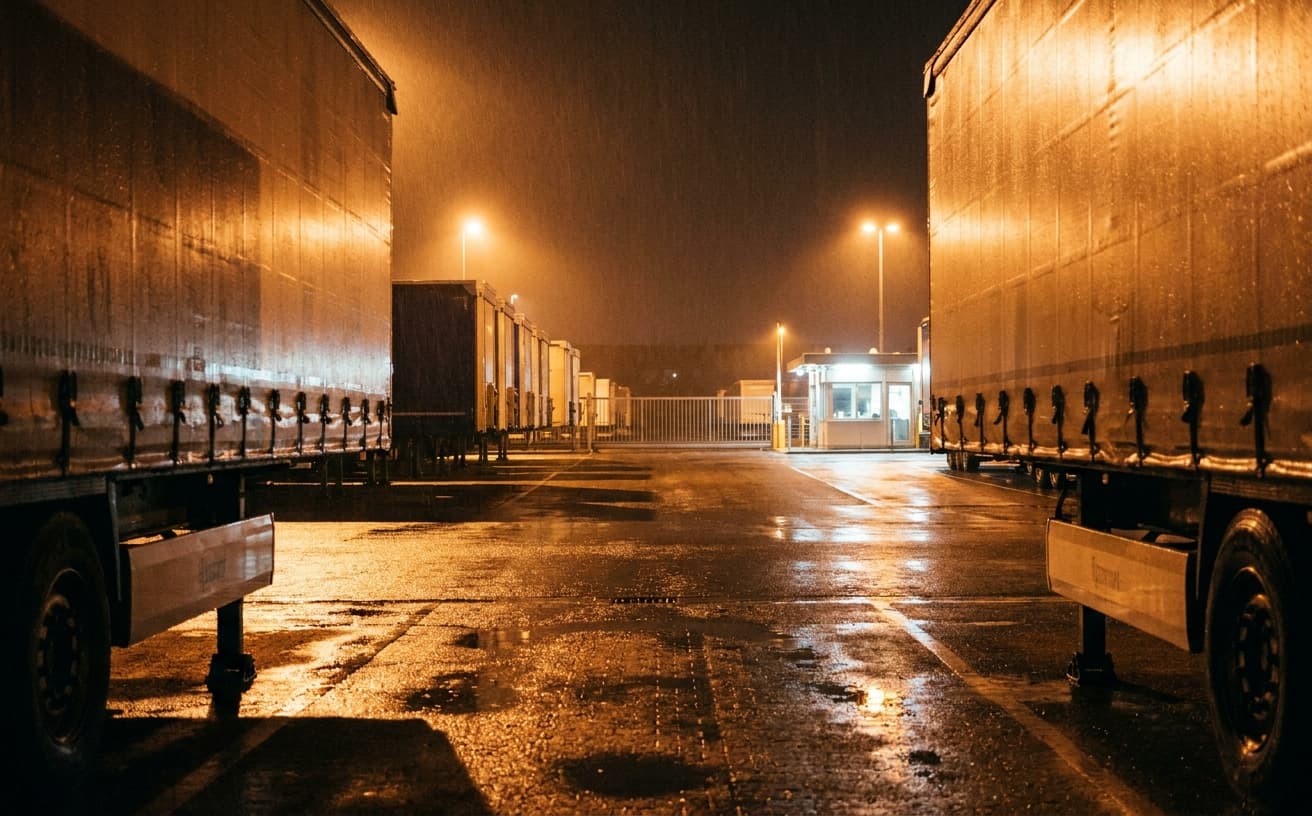
A British container port is no longer a logistics asset. It is a customs frontier with a fence around it, and the fence is the weakest part.
That sentence will read as polemic to anyone who has not stood in a yard at Felixstowe at three in the morning watching a tractor unit pull away from a stack of empties. It will read as obvious to anyone who has. The point of this article is to make the observation operational, to set out what has changed since the United Kingdom left the European customs union, what the threat picture at Felixstowe and Southampton actually looks like in the operator's hands, and what kind of physical and procedural security architecture matches that picture. The argument is written from a manufacturer's point of view, not a consultant's. We build the perimeter equipment, the mobile video towers, the security robots and the analytics that sit on top. We have an interest in being correct about what they do and what they do not.
What Brexit moved, in security terms
The conversation about Brexit at the ports has been dominated by tariffs, paperwork, and the politics of the Northern Ireland Protocol. From a security director's chair the more important shift is structural. Before 2021 a container arriving at Felixstowe from Rotterdam was, in customs terms, inside the same regime it had left. After 2021 it crosses a hard border. That sounds like a paperwork problem. It is, in fact, a dwell-time problem. Containers wait longer. They wait in larger holding stacks. They wait in yards that were never designed to be storage, only transit. Dwell is the single variable that drags theft risk upward more than any other, because the longer a container sits, the more time a hostile actor has to identify it, locate it, and access it.
HMRC's Border Operating Model, phased in from 2021 and into 2024 with the introduction of the Single Trade Window and the Border Target Operating Model, sits on top of this physical reality. Documentation requirements have multiplied at the agri-food and SPS layer in particular. Inland Border Facilities have absorbed some of the load, but a substantial portion of the customs interaction still happens at the port itself or in the immediate hinterland. The British Ports Association and the Chamber of Shipping have both, in different language, described the same point. Capacity that used to be fluid is now stationary. Stationary cargo is exposed cargo.
The second structural shift is informational. EU-wide data sharing in customs and law enforcement, which the United Kingdom participated in before 2021, was replaced by a patchwork of bilateral arrangements. Intelligence on organised cargo crime groups, the ones that work the Hamburg, Antwerp, Rotterdam and Le Havre corridor, no longer flows the way it did. NICB equivalent data in the British context comes through the National Crime Agency, the Joint Maritime Security Centre, and insurance loss adjusters. It is good data, but it is not the same data, and the gaps are felt at the operator level when a stolen consignment surfaces in a continental yard six weeks later and no one stitched the trail together in real time.
The Felixstowe geometry
Felixstowe handles roughly forty percent of the United Kingdom's container traffic. The site is large, linear, and bounded on three sides by water or salt marsh. That sounds defensible. In practice it is the landside boundary, the rail corridor, and the lorry park interfaces that carry almost all the residual risk. Hutchison Ports operates the terminal. The Port of Felixstowe Police, one of the small number of statutory port forces in the United Kingdom under the Marine Navigation Act framework, holds primary policing jurisdiction within the harbour estate. Suffolk Constabulary handles the wider area.
The geometry creates three concrete vulnerabilities the operator has to manage. The first is the holding stack. Post-Brexit dwell has expanded the volume of containers held for customs release. A holding stack is, by its nature, a stationary asset, and stationary assets attract reconnaissance. The second is the haulier interface at the gate. Documentation checks at the gate, both terminal-operator checks and customs checks, generate queues. A queue is a controlled space in theory and a soft target in practice, because the lorry park outside the controlled estate is not the operator's land. The third is the rail freight corridor. Containers transferred to rail at Felixstowe move through a sequence of yards inland where the security posture is the haulier's, not the port's. A cargo theft network that wants to take volume off the port does not, in general, attempt the port. It attempts the haulier yard at Daventry or Birmingham.
Felixstowe has invested heavily in perimeter electronics. CCTV coverage of the operational footprint is dense, and ANPR at the gates is mature. The remaining exposure is at the edges, on the marsh boundary, on the rail corridor at night, and at the perimeter sections that abut the public road network. These are the areas where mobile video towers and patrol robotics earn their place. A fixed camera looking at a marsh sees the marsh. A mobile platform that can be redeployed in response to an intelligence picture, and that carries thermal, optical and acoustic sensors in one column, sees what is moving across the marsh. The difference is operational, not technological.
The Southampton picture
Southampton is a different problem. Associated British Ports operates the estate. The terminal mix is more varied, with containers, vehicles, cruise and bulk all in one footprint. Vehicle handling at Southampton, in particular, generates a theft signature that container ports do not see. High-value vehicles, especially in the export flow to Asian and Middle Eastern markets, are a known target for organised vehicle theft networks. The pattern, documented by NICB equivalents in the British market and by underwriters at Lloyd's, is consistent. Vehicles are stolen in the United Kingdom inland, given false documentation, and exported through a roll-on roll-off berth. The port is not the origin of the theft. It is the point of egress, which means the security question at Southampton is as much about outbound document verification and chassis number checks as it is about perimeter intrusion.
The post-Brexit customs layer at Southampton has added a verification burden that the operator did not previously carry at the same intensity. Outbound containers and vehicles to EU destinations now generate the same documentation requirements as outbound to third countries. This has, by accident more than design, created an opportunity. The verification process now touches more consignments, which means an integrated security and customs workflow can catch more anomalies than it could under the pre-2021 regime. The technical condition is that the verification systems and the security systems share a data layer. Where they do not, the customs check sees one picture and the security operator sees another, and the gap between them is where the stolen Range Rover crosses the dock.
Southampton's perimeter is more constrained than Felixstowe's. The estate is closer to urban Southampton, the public road network is in immediate contact with the controlled boundary, and the cruise terminal generates pedestrian flows that change the threat profile through the year. A mobile, sensor-rich perimeter regime, layered on top of fixed CCTV, is the only economically viable answer to that variability. A static system sized for the cruise season is over-specified for January. A static system sized for January is under-specified for July. The argument for redeployable platforms is not a sales argument. It is an arithmetic argument.
Theft data and what it actually says
Cargo theft in the United Kingdom is under-reported and inconsistently coded. The figures published by the Road Haulage Association, by the National Vehicle Crime Intelligence Service, and by TAPA EMEA in their incident reporting framework do not align cleanly. The directional picture is consistent. Cargo theft has been rising in the United Kingdom since 2021, sharper in the road freight segment than in the maritime segment, and concentrated in the corridors connecting the major container ports to the inland distribution centres. Annual losses are estimated in the hundreds of millions of pounds, with high-value electronics, alcohol, tobacco, and pharmaceuticals over-represented relative to volume.
The maritime segment specifically, meaning theft from the port estate itself rather than from the road network feeding it, is a smaller absolute number but a more concentrated one. Insurers including the Joint Cargo Committee at Lloyd's have noted that incidents within port estates tend to be either opportunistic, often involving an insider element, or highly organised, involving prior reconnaissance and equipment. The middle category, the unprepared external intruder, is rare on a well-defended port. That matters for the design of the security architecture. A system optimised for opportunistic intrusion is a deterrence system, mostly visual. A system optimised for organised intrusion is a reaction system, mostly sensor-driven and integrated with a response capability. Most British ports run the first and need more of the second.
The Brexit-specific signature in the theft data is harder to isolate, but it is visible. Consignments held for extended customs release show a higher incident rate per container-day than consignments in normal transit. This is intuitive and the data confirms it. The operational consequence is that the customs holding area, wherever it sits within the estate, is the highest-priority security zone in the post-Brexit configuration, and in many ports it is not. It was designed as transit, not as storage, and it carries the security posture of transit. Closing that gap is the single most material change a British port security director can make in the next budget cycle.
Supplier landscape and the integration question
The British port security market is supplied by a mix of large integrators, mid-sized specialists, and increasingly, by technology manufacturers selling directly into the operator. The integrator model dominated through the 2000s and 2010s, with companies such as Securitas, G4S, Mitie and OCS providing manned guarding alongside electronic systems supplied by Honeywell, Bosch, Axis and Genetec. That model still functions, but it is under pressure on two sides. Manned guarding costs have risen faster than security budgets, and integrator margins on electronic systems have compressed as manufacturers have moved closer to the end user.
The pattern visible at Felixstowe, Southampton, London Gateway and the Forth Ports estate is a slow shift toward direct manufacturer relationships for the technology layer, with the integrator retained for installation and the security service company retained for monitoring and response. This is the right structural answer. It separates the three functions that should be separate, namely manufacture, integration and operation, and it gives the operator a procurement position that is not captive to a single supplier. The condition, as we argue in BOSWAU + KNAUER. From Building to Security Technology, is that the manufacturer must build to open standards, document interfaces, and accept that the operator will, at some point, run parts of the system independently. A manufacturer who locks the operator into proprietary protocols is selling a cage, not a system.
The relevant standards picture for British ports draws on IEC 62443 for industrial control system security, ISO 27001 for information security management, NIST CSF 2.0 for the cyber-physical layer where it touches operational technology, and the International Ship and Port Facility Security Code under SOLAS for the maritime regulatory baseline. CISA guidance from the United States, while not directly applicable, is referenced by British operators because the threat actor profile against critical maritime infrastructure does not respect jurisdiction. ASIS International's port security guidelines and the BSI's CPNI guidance, now under National Protective Security Authority, provide the practitioner-level material. None of these is sufficient on its own. The architecture that holds is the one that maps the regulatory standards to the operational reality of the specific port, and that requires a site-level audit rather than a generic specification.
HMRC integration and the data layer
The integration question that British port security directors have not, in our observation, fully solved is the interface between the security platform and the HMRC customs systems. Post-Brexit, the customs systems carry more data, more often, about more consignments, than they did before 2021. The Customs Declaration Service, the Goods Vehicle Movement Service, and the Single Trade Window all generate event data that, in principle, could feed a port's security operations centre. In practice they generally do not. The two data layers run in parallel, and the security operator works from CCTV, ANPR and access control logs, while the customs operator works from declaration data and inspection results.
The integration value is not theoretical. A consignment that has failed a customs check, that has been held for extended inspection, or that has triggered an anti-smuggling alert, is by definition a higher-risk container from a security standpoint. The operator who sees that flag in real time can position assets, including mobile video towers and patrol robotics, around the holding location. The operator who does not see it relies on the same generic perimeter posture for that container as for any other. The difference, measured in incident reduction, is significant where the integration has been built and measured at zero where it has not.
The barrier is not technical. The Single Trade Window has documented APIs. The security platforms in mature operator estates have northbound interfaces. The barrier is organisational and procurement-based. The customs function reports through one chain and the security function through another, and the integration project sits in the gap between them. The operators who have closed the gap, generally at the larger container ports, have done so by treating security and customs as a single intelligence problem rather than two separate compliance problems. That is a leadership question more than a technology question.
What holds
A British port in 2025 is operating under conditions that did not exist five years ago. Dwell times are longer, holding areas are larger, customs interactions are denser, and the intelligence environment is more fragmented. The perimeter and cargo security architecture has to match those conditions rather than the conditions of the previous decade. That means redeployable platforms over fixed-only installations, sensor fusion over single-channel CCTV, integration with HMRC data layers rather than parallel operation, and a procurement posture that keeps the operator in control of the technology rather than captive to a single supplier.
The economic case is straightforward. The cost of cargo theft and the cost of customs-related delay are both rising. Security spending that reduces both is not an overhead, it is an investment with a measurable return. The operators who treat it that way are the ones whose insurance premiums are stable and whose customer relationships, particularly with the high-value freight forwarders, are deepening. The operators who treat it as a fixed overhead are the ones who will find, in the next renewal cycle, that the market has moved past them.
For the security director who has read this far and recognises the description of their own estate, three paths are available. A confidential sixty-minute conversation, in which we set out what we would see at your specific site if we walked it. A three to five day audit, in which we walk it, with a defined deliverable at the end. A ninety-day pilot at one location, with a measurable success criterion agreed before installation. The choice between them is yours. The question, as the book argues, is not whether to engage with the post-Brexit security reality of British ports. It is when, and at what cost of waiting.
Frequently asked questions
How has Brexit changed port security?
The structural change is dwell time and customs interaction density. Containers spend longer in holding areas, customs checks touch more consignments, and the intelligence-sharing arrangements that existed under EU frameworks have been replaced by bilateral channels that work but work less smoothly. The operational consequence is that the customs holding area has become the highest-risk security zone in many ports, and it was generally designed as transit space rather than storage space. The architecture that fitted pre-2021 conditions is under-specified for post-2021 conditions, and the gap shows up in incident data.
What is being stolen?
The maritime theft signature is dominated by high-value electronics, alcohol, tobacco, pharmaceuticals, and at Southampton specifically, vehicles in the export flow. The volume figure is smaller than the road freight segment but the per-incident value is higher. Insider involvement is over-represented in port estate incidents compared to road incidents, which means access control, personnel vetting, and behavioural analytics on the data layer carry more weight than they do in pure perimeter defence. The data sources are TAPA EMEA, the Joint Cargo Committee, NaVCIS, and insurance loss adjusters, with the usual caveat that reporting is incomplete.
Who supplies the ports?
The historical supplier base is the large integrators, Securitas, Mitie, G4S, OCS, with technology from Bosch, Honeywell, Axis, Genetec, and increasingly, specialist manufacturers selling directly to the operator. The structural shift is toward separating manufacture, integration and monitoring, with the operator retaining procurement control over the technology layer rather than being captive to a single integrator's stack. Open standards, documented interfaces and modular architectures are the conditions that make this separation work. Closed proprietary systems lock the operator into a cost structure that becomes uneconomic over a five to seven year horizon.
How is HMRC integrated?
In most ports, not enough. The Customs Declaration Service, the Goods Vehicle Movement Service and the Single Trade Window generate event data that could feed the security operations centre but generally do not. The barrier is organisational rather than technical. Customs and security report through separate chains and the integration project sits in the gap between them. Where integration has been built, generally at the larger container terminals, the operator can position security assets in real time around higher-risk consignments. Where it has not, the perimeter posture is generic regardless of the customs status of the cargo behind it.
Related topics
- European Port Cargo Theft: TT Club 2025 Data Mapped
- Italian Port Security: Genoa, Trieste & La Spezia
- GCC Cargo Theft Corridors: Jebel Ali to Riyadh
- Cargo Theft Statistics 2026: The Carrier Breakdown
- Mobile Surveillance at the Port of Rotterdam
Take the next step: See prices & ROI · Explore the products · Send a no-obligation request. BOSWAU + KNAUER – direct from the factory in Filderstadt, reply within 5 working days.
About the author
Dr. Raphael Nagel (LL.M.) is founding partner of Tactical Management. He acquires and restructures industrial businesses in demanding market environments and writes on capital, geopolitics, and technological transformation. raphaelnagel.com
More reading
Since 1892.
The firm is reached at boswau-knauer.de or +49 177 2266267.